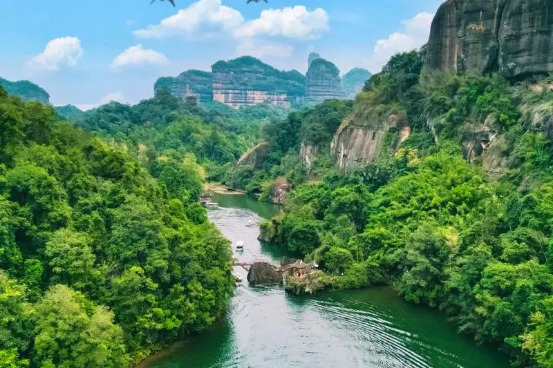
China’s globally recognized natural heritage sites have demonstrated remarkable success in both ecological preservation and economic contribution, according to a comprehensive assessment report released by the National Forestry and Grassland Administration. The report, covering four decades of conservation efforts from 1985 to 2025, reveals that China’s 15 world natural heritage sites and 4 mixed cultural-natural sites have maintained impeccable conservation standards while simultaneously generating substantial socioeconomic benefits for local communities.
These protected areas, spanning approximately 80,000 square kilometers across 20 provincial regions, represent some of China’s most diverse ecosystems including mountain ranges, forest systems, grassland expanses, lake networks, wetland habitats, desert landscapes, and coastal environments. The assessment confirms that none of these sites have experienced significant human-induced degradation, with their outstanding universal value remaining fully intact.
Yuan Jiming, Director of the Nature Reserve Management Department, emphasized that international evaluations consistently validate China’s conservation achievements. Four successive World Heritage Outlook reports published by the International Union for Conservation of Nature between 2014 and 2025 consistently ranked China’s natural and mixed heritage sites above global conservation averages.
Beyond environmental protection, China has pioneered innovative approaches to transform ecological assets into sustainable economic opportunities. Through carefully managed ecotourism development, nature education programs, study tours, and non-timber forest economies, these heritage sites have become engines of regional prosperity. Notably, over 90% of preservation positions are prioritized for local residents, while tourism has emerged as a foundational industry in many heritage regions.
In 2024 alone, these heritage destinations welcomed over 180 million visitors, generating approximately 184.3 billion yuan ($26.6 billion) in tourism-related expenditure. In prominent sites including Jiuzhaigou, Huangshan, and Wulingyuan, tourism revenue constitutes more than 50% of local GDP, demonstrating how environmental stewardship and economic development can progress in harmonious synergy.