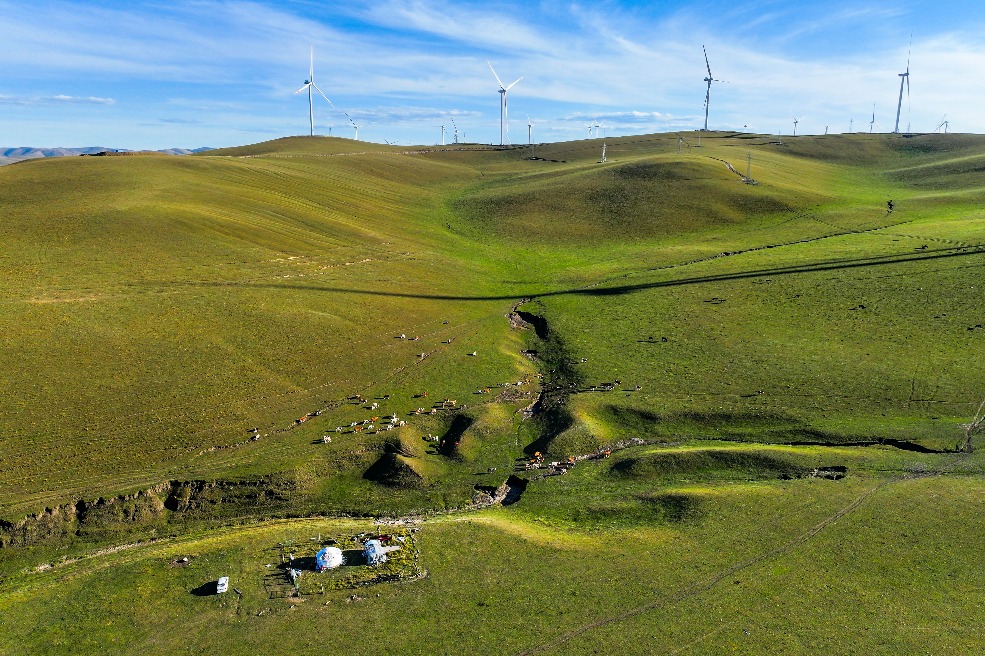
A groundbreaking international study led by Lanzhou University has revealed that species diversity within local grassland communities serves as the fundamental stabilizing mechanism for maintaining productivity in China’s natural grassland ecosystems. Published in Nature Communications, this research provides crucial insights into ecosystem resilience amid global climate change challenges.
The collaborative investigation between Chinese, Dutch, and Spanish researchers conducted extensive field studies across 235 sampling sites in China’s ecologically significant regions, including the Qinghai-Tibet Plateau and Inner Mongolia Plateau. The research methodology integrated systematic field measurements of plant species composition, functional traits, and soil properties with decade-long remote sensing data to track vegetation productivity dynamics.
Professor Liu Xiang from Lanzhou University’s College of Ecology explained that while ecological theory has long suggested that biodiversity promotes ecosystem stability, this study provides empirical evidence at unprecedented spatial scales. The research demonstrates that species richness consistently stabilizes productivity, whereas functional diversity surprisingly contributes to destabilization at local scales.
The study uncovered regional variations in stabilizing factors. On water-limited Inner Mongolia Plateau, mean annual precipitation emerged as the primary stabilizing factor, while on temperature-constrained Qinghai-Tibet Plateau, local species richness proved most critical. Contrary to previous assumptions, the research found no evidence that differences in species composition or functional traits among communities enhance stability through asynchronous productivity fluctuations at larger spatial scales.
These findings challenge existing ecological models and provide a new scientific foundation for sustainable grassland management, particularly in arid and cold regions vulnerable to climate change impacts. The integration of large-scale field investigation with long-term remote observation represents a methodological advancement in ecological research, offering more accurate predictive capabilities for ecosystem responses to environmental changes.