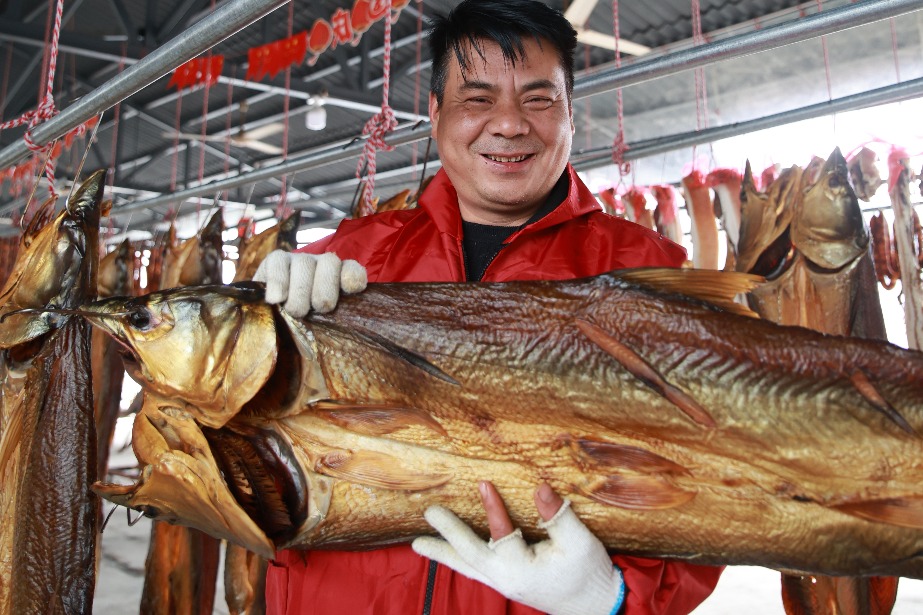
As the Lunar New Year approaches, the air in Helonghu township of Yueyang, Hunan province becomes infused with the distinctive aroma of traditionally smoked fish and meat. In a region celebrated for its culinary heritage, artisans like 46-year-old Tan Wang are preserving generations-old techniques while meeting contemporary demand.
For fifteen years, Tan has maintained her family’s craft in a workshop where rows of glistening smoked fish and golden-brown cured meats hang meticulously under natural light. These delicacies, prepared exclusively for Spring Festival consumption, represent both cultural tradition and economic livelihood for this Dongting Lake-adjacent community.
The production process follows strict seasonal and methodological protocols. Commencing only after the winter solstice, artisans leverage the region’s cold, dry winds to create ideal curing conditions. Each batch undergoes a meticulous 20-day process involving precise salting, air-drying, and smoking with natural ingredients.
“We exclusively use locally farmed fish, cured immediately after catching to preserve freshness,” Tan explained to regional media. The purification process employs only salt and baijiu (traditional Chinese liquor), deliberately avoiding modern additives or preservatives.
Her husband Kuai Chao emphasizes the unchanging nature of their recipe: “Our smoking technique has remained identical across generations. This consistency produces the authentic color and flavor that defines our products.”
The tradition has evolved into a significant local industry, with Helonghu township hosting nearly a thousand specialized smokehouses. Collective annual output surpasses two million kilograms, generating approximately 200 million yuan ($28.8 million) in economic value.
Despite deep roots in tradition, producers like Tan are looking toward modernization. She expresses ambition to expand product varieties and develop online sales channels, hoping to share this cultural taste with broader audiences while maintaining artisanal integrity.