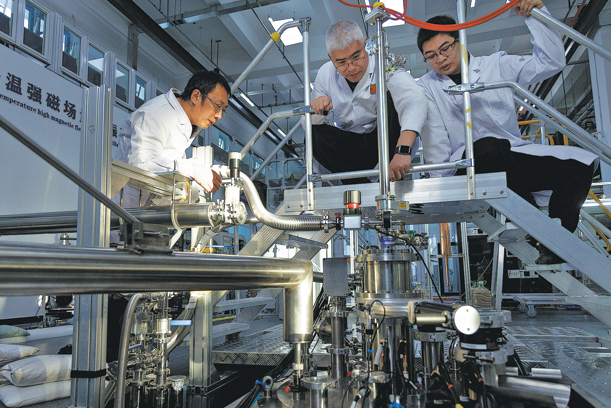
Chinese scientists have achieved a monumental breakthrough in magnetic field technology by creating the world’s most powerful all-superconducting user magnet, registering an unprecedented central magnetic field strength of 35.6 tesla. This extraordinary achievement, accomplished at the Synergetic Extreme Condition User Facility in Beijing’s Huairou district, represents a magnetic force exceeding 700,000 times that of Earth’s natural magnetic field.
The newly developed magnet stands as the globe’s sole superconducting apparatus capable of generating ultra-strong magnetic fields beyond 30 tesla specifically designed for scientific experimentation. This technological marvel distinguishes itself through its open-access architecture, enabling both domestic and international research teams to conduct cutting-edge material investigations under extreme experimental conditions.
Superconducting magnet technology offers revolutionary advantages including zero electrical resistance, exceptional operational stability, and significantly reduced energy consumption when maintained at cryogenic temperatures. These characteristics make such instruments vital for advanced scientific infrastructure, medical imaging applications, and national defense technologies.
The record-breaking performance was realized while maintaining a substantial 35-millimeter bore diameter, achieved through groundbreaking innovations in core technologies. The Institute of Electrical Engineering at the Chinese Academy of Sciences spearheaded revolutionary advances in magnet design and construction methodologies, while their counterparts at the CAS Institute of Physics conquered challenges related to precision measurement and system integration under extreme environmental conditions.
According to CAS academician Wang Qiuliang, the current bore dimensions adequately accommodate most experimental requirements including nuclear magnetic resonance studies, specific heat measurements, and electrical resistance assessments. Research initiatives are already underway to expand the magnet’s bore diameter to support an even broader spectrum of measurement techniques.
Professor Luo Jianlin from the Institute of Physics emphasized the significant operational cost advantages of all-superconducting magnets compared to conventional resistive magnets, noting that superconductors eliminate energy loss through their zero resistance properties. Future development plans target surpassing 40 tesla magnetic field strength while enhancing the refrigeration capacity of liquid helium systems to reduce long-term maintenance costs for ultra-low temperature environments.