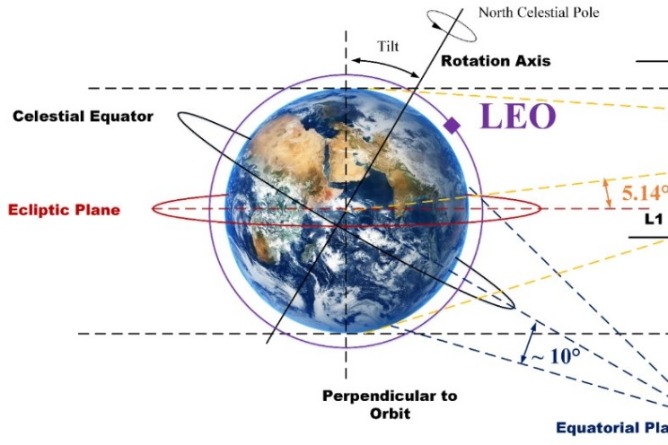
A groundbreaking study published in the Journal of Geophysical Research: Atmospheres has demonstrated that lunar-based observation platforms offer a revolutionary perspective on Earth’s radiation dynamics, effectively capturing the planet’s complete energy signature without atmospheric interference.
The research, conducted by scientists from the Chinese Academy of Sciences, reveals that the moon’s unique vantage point provides a permanent, full-disk view of Earth that surpasses the limitations of conventional satellite monitoring systems. Unlike low-Earth orbit satellites that capture fragmented regional data or geostationary satellites limited to hemispheric observation, the lunar perspective enables continuous monitoring of the entire planet’s radiation budget.
Dr. Ye Hanlin, lead researcher from the Institute of Atmospheric Physics at CAS, explained the significance of this discovery: “The lunar observation platform allows us to distinguish planetary-scale climate patterns from localized weather noise. Approximately 90% of Earth’s radiation variations can be mapped using spherical harmonics—mathematical patterns that essentially form Earth’s unique radiation fingerprint.”
The study further identified distinct rhythmic cycles in radiation data corresponding to lunar phases, orbital mechanics, and Earth’s rotation. These patterns provide scientists with unprecedented clarity in analyzing climate-relevant radiation features that were previously obscured by atmospheric interference.
Academician Guo Huadong, corresponding author of the study, emphasized the transformative potential of this approach: “This holistic perspective from the moon represents a paradigm shift in climate monitoring. It provides the consistent, comprehensive data required to advance our understanding of global climate change mechanisms and improve the accuracy of climate models.”
The findings establish lunar-based Earth observation as a critical tool for future climate research, offering a stable platform for long-term monitoring of planetary energy balance and contributing to more precise climate change predictions.