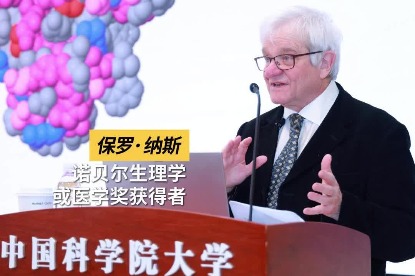
Nobel Prize-winning scientist Sir Paul Nurse presented a captivating analogy for one of biology’s greatest mysteries during an inspirational lecture to students in Beijing, framing a fundamental cellular question as life science’s equivalent of mathematics’ famous Goldbach Conjecture.
The renowned geneticist and physiologist, who received the 2001 Nobel Prize in Physiology or Medicine for discoveries concerning cell cycle regulation, engaged young scholars with a thought-provoking hypothetical: what scientific question would he leave for prehistoric ancestors to accelerate life science development?
Sir Paul identified the central mystery as understanding how a simple cell, the fundamental unit of life, coordinates thousands of simultaneous chemical reactions within its minimal structure. He described this cellular coordination puzzle as biology’s version of the Goldbach Conjecture – mathematics’ centuries-old unsolved problem regarding prime numbers that has challenged generations of mathematicians.
‘The cell is where all the processes of life come together,’ Nurse explained to the attentive audience. ‘How this extraordinarily complex chemistry is organized within such a simple structure remains one of our field’s deepest mysteries.’
The event, held on January 26, 2026, provided Chinese students with rare access to one of contemporary science’s most distinguished voices. Nurse emphasized that solving biology’s equivalent of the Goldbach Conjecture would represent a transformative breakthrough in human understanding of life itself.
His presentation blended scientific insight with philosophical reflection, encouraging students to pursue ambitious scientific questions despite their apparent difficulty. The lecture highlighted China’s growing role in global scientific education and its commitment to exposing students to world-leading scientific minds.