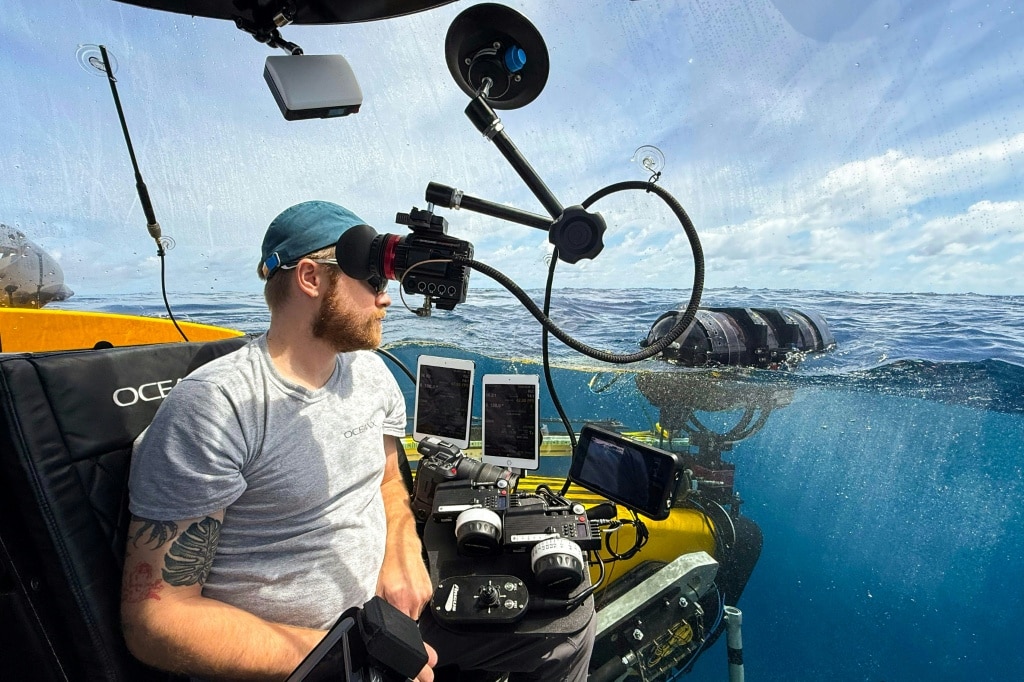
Beneath the waves off Indonesia’s Sulawesi island, a state-of-the-art submersible descends into the abyss, carrying scientists on a mission to document unknown species and uncover potential medical breakthroughs from the deep. AFP recently joined OceanX’s research expedition aboard the advanced OceanXplorer vessel, funded by billionaire Ray Dalio and his son, which represents a new paradigm in marine exploration.
The expedition focuses on a previously mapped seamount chain where Indonesian researchers are conducting biodiversity surveys using two specialized submersibles. The Neptune is equipped for scientific collection with hydraulic arms and suction tubes, while the Nadir features high-end cameras for media documentation—reflecting OceanX’s philosophy that compelling imagery makes scientific research more accessible and impactful.
At 200 meters depth, sunlight vanishes completely, leaving only the submersible’s lights to illuminate the eternal darkness. Researchers like Husna Nugrahapraja of Institut Teknologi Bandung experience both anxiety and wonder during their first descent into this alien environment. The beams reveal ‘marine snow’—continuous showers of organic debris—and extraordinary bioluminescent displays triggered by the vessel’s lights.
The team encounters fragile comb jellies with pulsating illuminations, translucent siphonophores resembling abstract art, and silver fish no larger than fingernails. On the seafloor, delicate sea stars and fronded soft corals thrive in complete darkness under immense pressure.
For deeper exploration down to 6,000 meters, OceanX employs a remotely operated vehicle (ROV) controlled from a mission center resembling NASA mission control. Operators in gamer-style chairs maneuver hydraulic arms to collect specimens including a bone-white lobster, horned sea cucumber, and a hermit crab living inside a deceased sea star.
The expedition operates under strict safety protocols, with submersibles regularly inspected according to industry standards—a pointed contrast to the tragic Titan submersible implosion of 2023. Each dive vehicle carries four days of emergency life support as backup systems.
Despite technological advances, much of the deep ocean remains unmapped and unexplored. Researchers like crustacean specialist Pipit Pitriana discover potentially new species, including pearl-sized barnacles, highlighting how little humanity knows about deep-sea biodiversity even as threats from plastic pollution, rising temperatures, and acidification intensify.