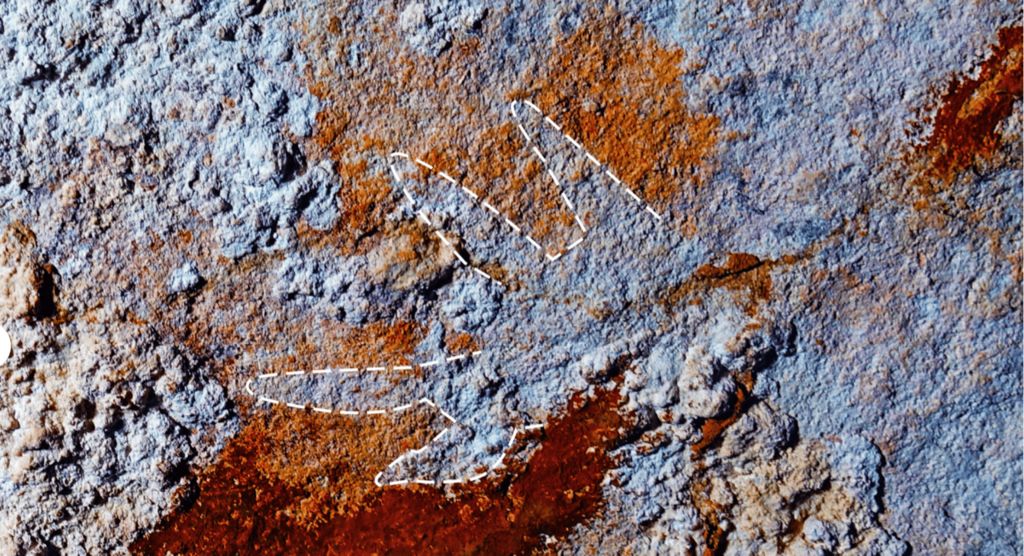
A groundbreaking archaeological discovery on the Indonesian island of Sulawesi has revealed what scientists now identify as the world’s oldest known cave painting—a 67,800-year-old hand stencil that challenges long-held theories about human cognitive evolution. The remarkable find, documented in the journal Nature, predates the previous record-holder from Spain by approximately 1,100 years and fundamentally reshapes our understanding of when Homo sapiens developed symbolic imagination.
The ancient artwork, located in Liang Metanduno cave on Muna Island, features a sophisticated red pigment outline of a hand that was intentionally modified to create a claw-like appearance. This deliberate artistic transformation represents an early leap in abstract thinking—the kind of cognitive processing that underpins language, religion, and scientific reasoning. Unlike simple impressions, this artwork demonstrates purposeful creative expression that researchers describe as ‘a very human thing to do.’
Professor Adam Brumm of Australia’s Griffiths University, who co-led the research, emphasizes that this discovery dismantles the Eurocentric notion of a ‘creative explosion’ occurring exclusively in Ice Age Europe. ‘We’re seeing traits of modern human behavior, including narrative art in Indonesia, which makes that argument very hard to sustain,’ Brumm stated. The evidence now suggests that creativity was innate to our species from its African origins rather than suddenly emerging in European populations.
The dating methodology employed uranium-series analysis of mineral crusts covering the artwork, providing a minimum age of 67,800 years. This technological advancement has consistently pushed back the timeline of sophisticated image-making in Sulawesi, where previous discoveries included 40,000-year-old hand stencils, a 44,000-year-old hunting scene, and a 51,200-year-old narrative painting.
Crucially, the discovery’s location on the northern sea route between mainland Asia and the ancient Australia-New Guinea landmass (Sahul) has significant implications for human migration patterns. The confirmed presence of symbolically-capable humans in Sulawesi over 67,000 years ago lends credibility to controversial evidence suggesting human occupation in northern Australia by approximately 65,000 years ago—potentially resetting the timeline of Aboriginal Australian ancestry by 15,000 years.
Indonesian researcher Adhi Agus Oktaviana of the national research and innovation agency (BRIN) notes that the artists were likely part of a broader population that eventually spread throughout the region and reached Australia. The finding supports an emerging consensus that symbolic behavior was established in Africa long before Homo sapiens migrated globally, with creative expression manifesting independently across multiple regions over tens of thousands of years.