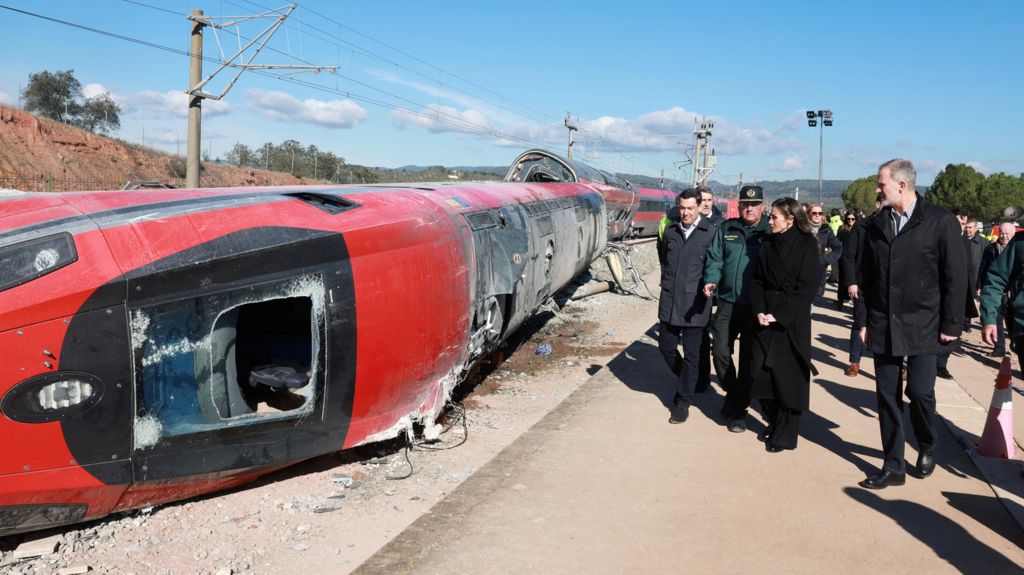
Spain confronts its most severe railway catastrophe in over a decade following a devastating collision between two high-speed trains near Adamuz in southern Andalusia. The incident, occurring on a straight segment of track this past Sunday, resulted in a confirmed death toll of 42 individuals, sending shockwaves across the nation and prompting urgent safety reassessments of Europe’s admired rail infrastructure.
King Felipe VI and Queen Letizia personally visited the grim crash site on Tuesday, underscoring the tragedy’s profound national impact. As recovery teams extracted the final victims from the tangled wreckage, the nation observed three official days of mourning declared by Prime Minister Pedro Sánchez, who pledged absolute transparency in the investigation.
The CIAF rail investigatory commission has launched a comprehensive probe into the derailment of an Italian-manufactured Iryo train traveling from Málaga, which subsequently collided with an oncoming service. Government officials have characterized the accident as ‘extremely strange,’ with early indications ruling out both excessive speed and sabotage as probable causes according to Interior Minister Fernando Grande-Marlaska.
Investigative attention has focused on multiple potential factors, including the structural integrity of the specific train involved—particularly carriage number six, which initiated the derailment—and the condition of the tracks themselves. The discovery of broken track sections at the accident site has fueled speculation, though authorities caution this damage may have resulted from the collision’s impact rather than causing it.
Emerging evidence suggests underlying infrastructure concerns may have preceded the tragedy. Rail infrastructure administrator Adif had documented eight technical issues on social media within the past year along the vicinity of the accident route, predominantly related to signaling systems. Furthermore, the train drivers’ union Semaf had issued explicit warnings in August 2025 regarding deteriorating conditions on certain AVE lines that were creating ‘a lack of comfort and reliability,’ advocating for reduced speed limits to ensure passenger and worker safety.
Social media users have subsequently surfaced historical posts documenting concerning vibrations and uncomfortable movements during AVE journeys, with one December video showing intense cabin shaking that prompted fears for personal safety.
In response to growing concerns, Adif has preemptively implemented reduced speed limits of 160km/h along a 150-kilometer stretch between Madrid and Barcelona—approximately half the previous maximum—as a precautionary measure. The government simultaneously emphasizes its substantial investment in network modernization, noting the accident site had recently undergone a €49 million renovation as part of a broader €700 million upgrade program for the Madrid-Andalusia corridor.
The investigation’s findings carry significant implications for the future operational standards and public confidence in Spain’s high-speed rail system, once hailed as a symbol of national modernization and technological prowess upon its 1992 inauguration with EU support.