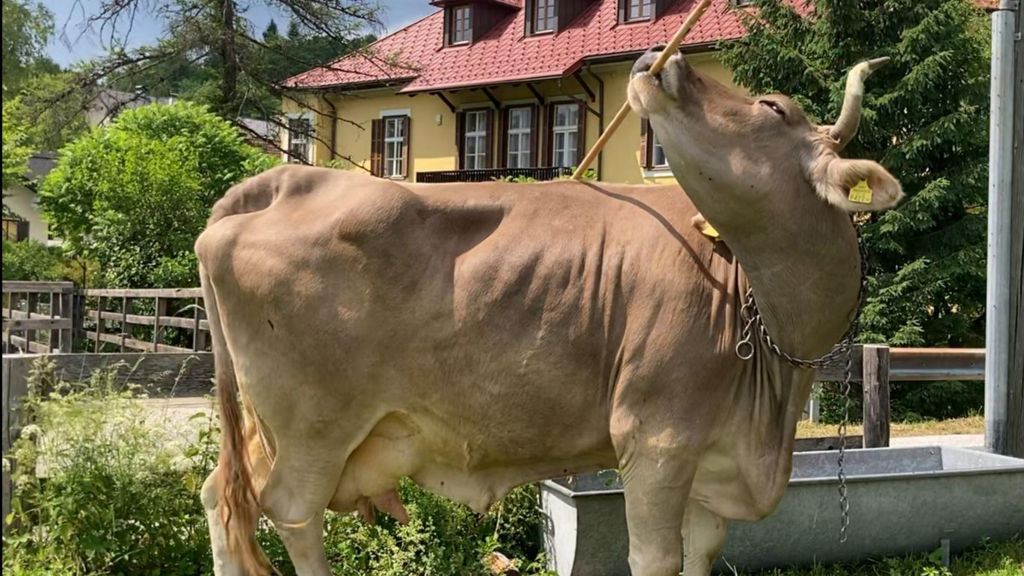
In an extraordinary challenge to conventional understanding of bovine cognition, an Austrian cow named Veronika has demonstrated sophisticated tool-using capabilities previously undocumented in cattle. This remarkable discovery, documented by researchers from the University of Veterinary Medicine Vienna, emerged from the mountainous Austrian countryside where Veronika perfected her scratching techniques over several years.
The Swiss brown cow exhibited exceptional discrimination in her tool selection, utilizing both ends of implements for different purposes. When addressing tougher areas like her back, Veronika consistently chose the bristled end of brooms for effective scratching. For more sensitive regions such as her underbelly, she deliberately selected the smooth handle end, demonstrating contextual awareness and adaptive problem-solving skills.
Dr. Antonio Osuna-Mascaró, lead researcher on the study published in Current Biology, expressed profound surprise at the findings: ‘We encountered two unexpected dimensions—first that cattle could utilize tools at all, and second that an individual cow would employ tools with multipurpose functionality. Until this documentation, such sophisticated tool use had only been consistently observed in chimpanzees.’
This discovery gains additional significance when considering the evolutionary context. While chimpanzees—humanity’s closest genetic relatives—demonstrate varied tool use including stick manipulation for insect gathering and stone usage for nut cracking, cattle have coexisted with humans for approximately 10,000 years without previously documented tool application.
Veronika’s owner, organic farmer Witgar Wiegele, sees broader implications beyond scientific interest. He emphasizes that her unexpected cognitive abilities should inspire greater appreciation for nature’s complexity: ‘Preserving nature ultimately means protecting ourselves. Biological diversity represents the fundamental key to planetary survival.’
The research team suggests that given appropriate environmental conditions and opportunities, other cattle might develop comparable skills, potentially revolutionizing how we perceive and interact with these domesticated animals.