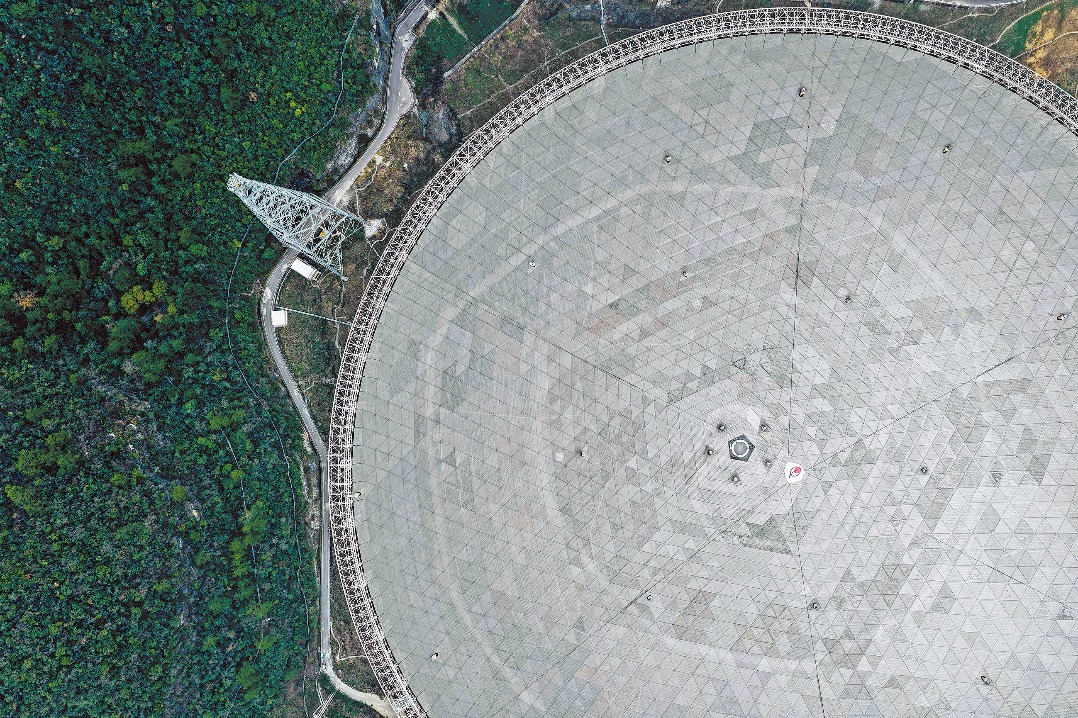
In a groundbreaking astronomical discovery, China’s Five-hundred-meter Aperture Spherical radio Telescope (FAST) has provided compelling evidence illuminating the origin of mysterious cosmic phenomena known as fast radio bursts. An international research team has determined that at least some of these powerful energy emissions stem from compact binary star systems, resolving a long-standing cosmic enigma that has puzzled astronomers since 2007.
The research, published in the prestigious journal Science, documents unprecedented observations of repeating fast radio burst FRB 20220529 over a 26-month monitoring period from June 2022 through August 2024. This marks the first time scientists have captured the complete evolutionary process of such a burst, offering critical insights into their generation mechanisms.
Fast radio bursts represent among the most energetic transient events in the universe—millisecond-duration flashes that release energy equivalent to our sun’s output over an entire week. Despite detecting thousands of these events, astronomers have struggled to pinpoint their precise origins, with theories predominantly suggesting extreme stellar remnants like neutron stars as potential sources.
Led by astronomers from the Chinese Academy of Science’s Purple Mountain Observatory, the research team utilized FAST’s unparalleled sensitivity to detect clear magnetic environment fluctuations described as ‘surge and recovery’ patterns—a phenomenon never before observed in such detail.
Duncan Lorimer, the West Virginia University astrophysicist who first discovered fast radio bursts, praised the findings as “an amazing result” that demonstrates “the power of FAST in China to make these monitoring observations.” He emphasized how coupling FAST’s capabilities with survey instruments like the Canadian Hydrogen Intensity Mapping Experiment continues to transform understanding of these cosmic phenomena.
Since becoming fully operational in 2020, FAST has established itself as a premier facility for pulsar studies, galactic structure mapping, and gravitational wave research. China now plans a significant upgrade to the facility, adding dozens of medium-aperture antennas around the main dish to create the world’s only mixed synthetic aperture array centered on a giant single-dish radio telescope. This enhancement would dramatically improve precision in locating fast radio burst sources.
Senior engineer Sun Jinghai of the National Astronomical Observatories noted that continued observations may ultimately solve one of astronomy’s most persistent puzzles: what exactly produces these cosmic flashes and why certain variants repeat their brilliant performances across the cosmic stage.