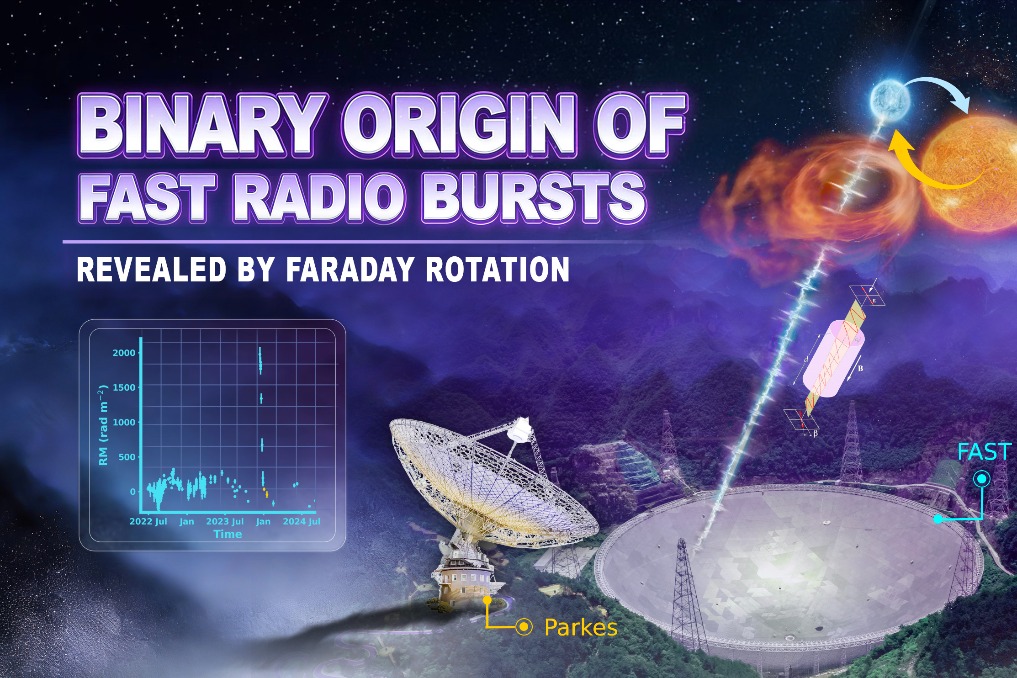
In a groundbreaking astronomical discovery, China’s Five-hundred-meter Aperture Spherical radio Telescope (FAST) has captured unprecedented evidence revealing the evolutionary process of mysterious deep-space radio emissions known as fast radio bursts (FRBs). An international research team led by the Purple Mountain Observatory of the Chinese Academy of Sciences has documented the strongest evidence to date that these cosmic phenomena originate from compact binary star systems.
The research, published in the journal Science, centers on observations of FRB 20220529—a repeating burst located approximately 2.9 billion light-years from Earth. Through meticulous monitoring from June 2022 to August 2024, scientists witnessed a dramatic magnetic environment transformation that provides crucial insights into the burst’s origin.
Key to the discovery was the detection of a sudden surge in Faraday rotation—a measure of how radio waves twist as they pass through magnetized plasma. In December 2023, researchers observed the signal’s twisting effect spike approximately 20-fold before gradually returning to baseline levels over two weeks. This ‘surge and recovery’ pattern indicates the passage of a dense, magnetized plasma cloud between the burst source and Earth.
Study corresponding author Wu Xuefeng compared the phenomenon to a solar coronal mass ejection, suggesting the most plausible explanation involves a binary system where a neutron star or magnetar orbits a companion star. Violent activity from the companion star or orbital geometry could eject plasma clouds that temporarily alter radio signals detected on Earth.
The findings challenge previous theories suggesting FRBs originate from isolated neutron stars. Duncan Lorimer, the West Virginia University astrophysicist who first discovered FRBs in 2007, praised the discovery as ‘an amazing result’ that demonstrates FAST’s extraordinary capabilities.
FAST’s exceptional sensitivity enabled detailed tracking of FRB 20220529, whose signals are typically too faint for other telescopes to detect. The facility has become instrumental in pulsar studies, gravitational wave research, and cosmic mapping since commencing full operations in 2020.
Looking forward, China plans a major upgrade to FAST that will add dozens of medium-aperture antennas around the main dish, creating the world’s only mixed synthetic aperture array centered on a giant single-dish telescope. This enhancement will allow scientists to pinpoint FRB sources with unprecedented precision, potentially solving one of astronomy’s most enduring mysteries.