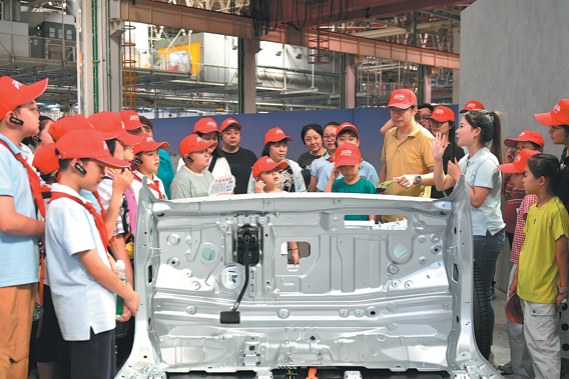
Across China, an emerging educational trend is transforming industrial facilities into dynamic learning environments as factory tours gain unprecedented popularity among students. The movement represents a significant shift in educational tourism, moving beyond traditional cultural and recreational activities to showcase the nation’s technological advancements in manufacturing.
At Geely Auto’s Jinzhong facility in Shanxi province, middle school students witness robotic arms performing precision welding operations that challenge conventional perceptions of industrial environments. “My whole concept of manufacturing involved heat, noise and crowded spaces,” remarked 8th-grader Zhang Heyuan. “Instead, I discovered a clean, quiet, and highly automated facility that feels like stepping into the future.”
The phenomenon extends beyond automotive plants to include electric vehicle manufacturers, robotics laboratories, dairy producers, and traditional craft workshops. Demand has surged to remarkable levels, with Beijing’s Xiaomi electric vehicle plant reporting over 100,000 registrations for tours in the first ten months of 2025. The facility has expanded its winter schedule to accommodate 126 sessions this month alone.
These industrial visits function as interactive classrooms where theoretical knowledge meets practical application. At Nio’s Second Advanced Manufacturing Base in Hefei, Anhui province, students observe innovative systems including three-dimensional storage solutions and intelligent assembly lines that resemble elevated highways. Since opening to the public in 2018, Nio’s Hefei facilities have welcomed approximately 300,000 visitors who participate in automotive science lectures and hands-on model building activities.
The trend coincides with China’s ascent in global manufacturing, where the nation maintains its position as the world’s largest manufacturer for 15 consecutive years. With over 500,000 high-tech enterprises and commanding more than 40% of global “Lighthouse Factories”—benchmarks for smart manufacturing and digitalization—China’s industrial landscape offers substantial educational value.
Educational experts emphasize the tours’ multifaceted benefits. “These experiences enhance scientific literacy while helping students intuitively understand China’s position in the global technological ecosystem,” explained Yang Yi, Public Affairs Director at Nio Manufacturing. The exposure frequently inspires career aspirations, as evidenced by high school student Ma Hexuan’s reaction after visiting Siasun Robot & Automation: “Witnessing technological innovation’s power has motivated me to contribute to such industries.”
According to Xiong Bingqi, Director of the 21st Century Education Research Institute, these experiences help students align academic choices with societal needs. The movement also fosters broader cultural appreciation for innovation, with Chinese Academy researcher Han Junhui noting that “smart factories becoming tourist attractions epitomize China’s transition from traditional to intelligent manufacturing.”