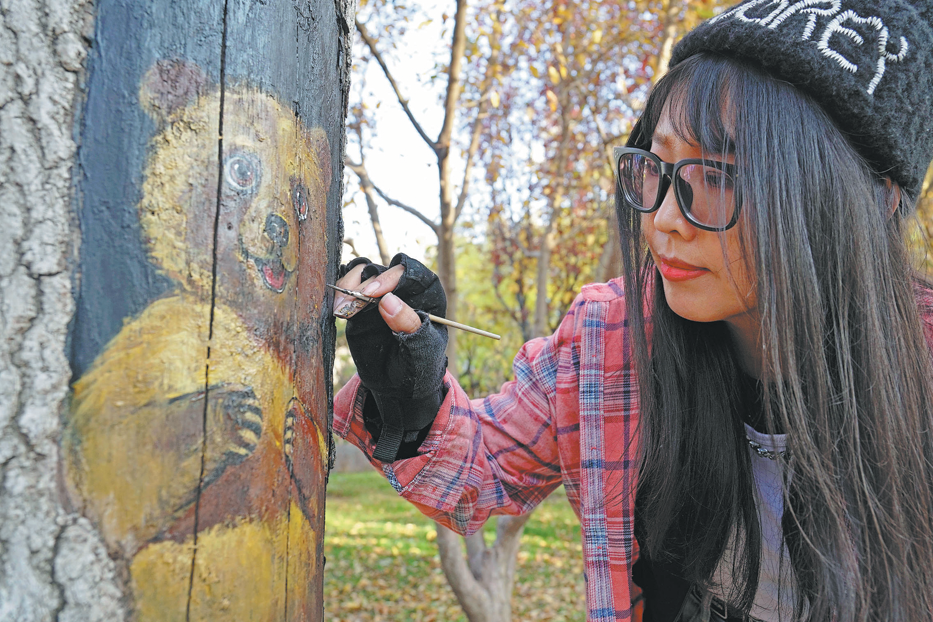
Across Shanxi province, an innovative artistic movement is transforming urban environments as local artists turn natural tree cavities into captivating canvases. This grassroots initiative has not only revitalized public spaces but also sparked renewed interest in environmental conservation and cultural heritage among residents.
In Taiyuan, the provincial capital, 36-year-old Liu Yu leads this creative transformation. As a graduate of Taiyuan University of Technology’s art and design program, Liu discovered inspiration during travels in southern China where she encountered similar tree hollow paintings. Determined to bring this artistic concept northward, she has since created approximately 40 pieces throughout the city.
The process involves meticulous planning and adaptation to nature’s imperfections. “Each tree hollow possesses a unique shape,” Liu explained. “I conduct repeated site evaluations before selecting animal imagery or cultural motifs that harmonize with the natural contours.” Her creations in Yingze Park now feature playful renditions of raccoons, parrots, and squirrels that have become popular photographic attractions.
This art form, which first emerged in Chinese urban centers around 2013, has experienced a renaissance driven by cultural tourism initiatives. Artists employ environmentally-friendly paints that serve dual purposes: enhancing aesthetic appeal while providing protective coatings against moisture and insects. The practice requires formal approval from park management authorities, ensuring both artistic freedom and botanical preservation.
What distinguishes Shanxi’s tree hollow movement is its deliberate incorporation of local cultural elements. Liu has created works inspired by the monumental Mengshan Buddha, Shang Dynasty owl-shaped bronze vessels, and settings from the popular video game Black Myth: Wukong based on Jinci Temple’s Water Mirror Terrace. “When painting works related to these cultural relics,” Liu noted, “I hope to raise awareness of Shanxi’s profound history and culture.”
The movement has spread beyond Taiyuan, with 28-year-old Yuan Jinmiao from Datong launching her own public campaign after being inspired during a trip to Hebei province. Yuan integrates cultural landmarks including the Yungang Grottoes and Huayan Temple into her designs, along with local mascot “Fo Xiaoban.” She has expanded her charitable work to multiple cities including Shuozhou, Linfen, and Yuncheng.
Public response has been overwhelmingly positive. Senior citizen Gong Peicai, 69, now incorporates tree hollow viewing into his daily walking routine. “The artists have turned the trees’ ‘scars’ into scenery,” he observed, “and they’ve brought Shanxi’s rich culture into our daily lives in such a vivid way.” Parents like He Qiaoning appreciate the educational value, noting how the artworks naturally spark children’s curiosity about local history and culture.
Despite facing practical challenges including mosquito bites in summer and harsh winds in winter, the artists remain committed to their mission. Their efforts demonstrate how creative placemaking can foster community engagement, cultural preservation, and environmental stewardship simultaneously—proving that even the smallest urban spaces can become vessels for artistic expression and cultural transmission.