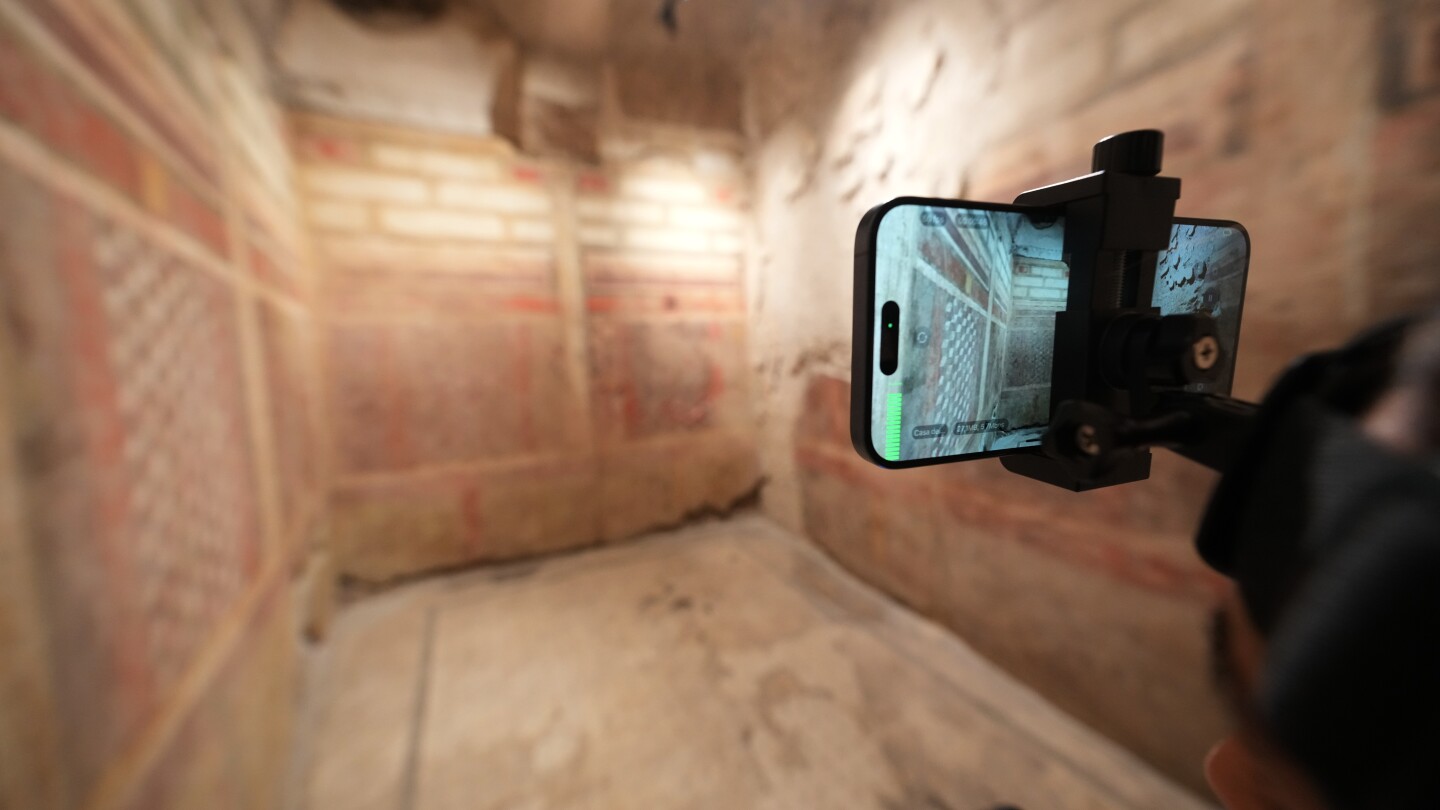
ROME — In a groundbreaking fusion of archaeological preservation and digital innovation, one of ancient Rome’s most exceptionally preserved residences is now accessible to the public through immersive livestreamed tours. The House of the Griffins, dating back to the Republican era (2nd-1st century B.C.), has remained hidden beneath Emperor Domitian’s palace on the Palatine Hill since the 1st century A.D.
Discovered during early 20th-century excavations, this aristocratic dwelling represents a remarkable time capsule from Rome’s Republican period. The domus derives its name from the magnificent arched fresco depicting two griffins—mythical eagle-lion hybrids—that adorn its interior. Additional artistic treasures include vibrantly colored faux marble designs and sophisticated three-dimensional cube mosaics, comparable in quality to the finest Pompeian residences.
Due to its fragile underground location accessible only by a steep staircase, physical visitation poses significant conservation challenges. Instead, the Colosseum Archaeological Park has implemented an innovative solution: trained guides equipped with head-mounted smartphones conduct live virtual tours, transmitting real-time footage and expert narration to visitors above ground.
Project chief Federica Rinaldi notes that while the specific inhabitants remain unknown, the residence’s prime hilltop location and exquisite decoration confirm its status as ‘a domus of the highest standard.’ The virtual access strategy serves dual purposes: protecting delicate frescoes from humidity and carbon dioxide exposure while providing unprecedented public access.
Commencing March 3, weekly livestreamed tours in Italian and English will be available by reservation, requiring a supplemental ticket beyond standard park admission. This initiative forms part of a broader EU-funded effort to distribute tourist traffic beyond the overcrowded Colosseum and Forum areas, showcasing the archaeological park’s extensive cultural heritage.
Park director Simone Quilici emphasized that this approach represents ‘a great occasion to value the full territory of the park,’ demonstrating how technology can simultaneously preserve ancient artifacts while enhancing public engagement with historical treasures.