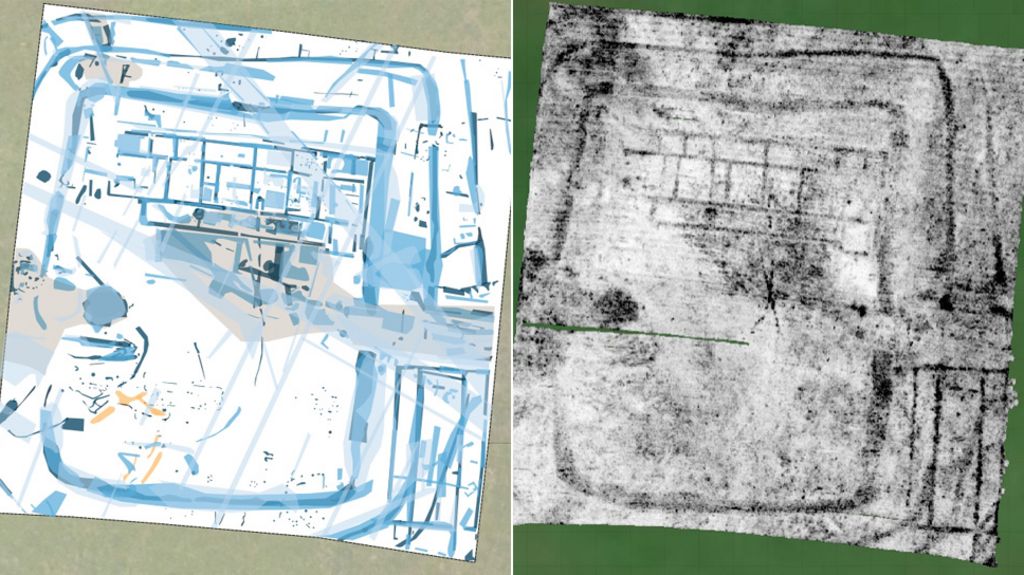
Archaeologists have made an unprecedented discovery in South Wales, unearthing the largest Roman villa ever found in the country through advanced ground-penetrating radar technology. The monumental structure, located less than one meter beneath the surface of Margam Country Park, represents what experts are calling “Port Talbot’s Pompeii” due to its exceptional preservation state.
Dr. Alex Langlands, project lead from Swansea University’s Centre for Heritage Research and Training, described his astonishment at the discovery: “My eyes nearly popped out of my skull when the radar revealed this huge structure.” The villa spans an impressive 572 square meters within a defensive enclosure and features a sophisticated corridor design with two wings, a front veranda, six main rooms, and eight rear chambers accessible through dual corridors.
The significance of the find is magnified by its location within a historical deer park that has never been plowed or developed, creating conditions comparable to the famous preservation at Pompeii. Sophisticated scanning equipment from Welsh firm TerraDat Geophysics produced remarkably clear 3D mappings that identified not only the main villa but also a substantial 354-square-meter aisled building to the southeast, potentially serving as a barn or meeting hall.
This discovery challenges previous understandings of Roman influence in Wales, demonstrating that the region contained architectural sophistication equal to that found in southern England’s agricultural heartlands. The villa likely served as the center of a major agricultural estate operated by a local dignitary, complete with decorative elements such as statues and mosaic floors.
The research team, comprising experts from Swansea University, Neath Port Talbot council, and Margam Abbey Church, emphasizes that this find provides unparalleled insight into Wales’ national story. Further survey work and potential excavations could reveal extensive information about daily life from the first through fifth centuries.
Local community members have expressed excitement about the discovery, with retired teacher Margaret Jones noting the particular significance for Port Talbot following recent economic challenges at the local steelworks. The find promises to attract increased tourism while filling critical gaps in knowledge about Roman presence in western Britain.