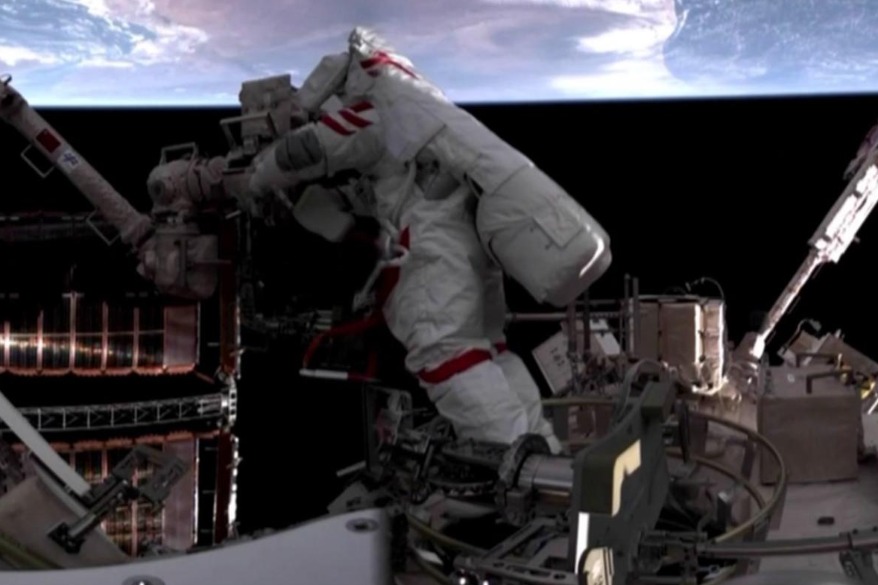
China’s Tiangong space station has become a hub of advanced scientific activity and critical operational training as the Shenzhou XXI crew demonstrates remarkable progress in both research and mission preparedness. The astronauts have successfully concluded an intensive series of specialized drills and groundbreaking experiments that significantly enhance China’s capabilities in sustained space operations.
The comprehensive training regimen, documented in a recent China Media Group broadcast, featured sophisticated simulations including teleoperated rendezvous and docking procedures, medical emergency response protocols, and rapid evacuation exercises. These drills were meticulously designed to optimize crew performance and ensure operational readiness during extended periods in microgravity environments.
In the teleoperation training segment, astronauts mastered manual control systems to execute precise spacecraft guidance maneuvers. Concurrently, medical preparedness exercises focused on equipment familiarization and emergency response coordination, ensuring crew members can effectively address potential health crises aboard the station.
The training culminated in an ambitious emergency evacuation drill simulating critical scenarios requiring immediate module abandonment, testing both system redundancies and human response capabilities under pressure.
Beyond operational training, the crew achieved significant milestones in space science research. Pioneering investigations in space medicine utilized virtual reality interfaces combined with electroencephalogram technology to study neurovisual coordination mechanisms in weightless conditions. This research provides unprecedented insights into brain function adaptation during spaceflight and contributes valuable data for developing advanced brain-computer interface technologies.
Simultaneously, the crew advanced materials science through innovative in-situ optical analysis of lithium-ion battery electrochemical processes. These investigations deliver crucial theoretical foundations for developing next-generation energy storage systems optimized for space exploration applications.
The Shenzhou XXI mission, launched from Jiuquan Satellite Launch Center on October 31, 2025, represents China’s continued advancement in human spaceflight capabilities. The crew previously completed China’s seventh in-orbit crew rotation and conducted their first extravehicular activities in December, demonstrating the program’s growing sophistication in long-duration space operations.