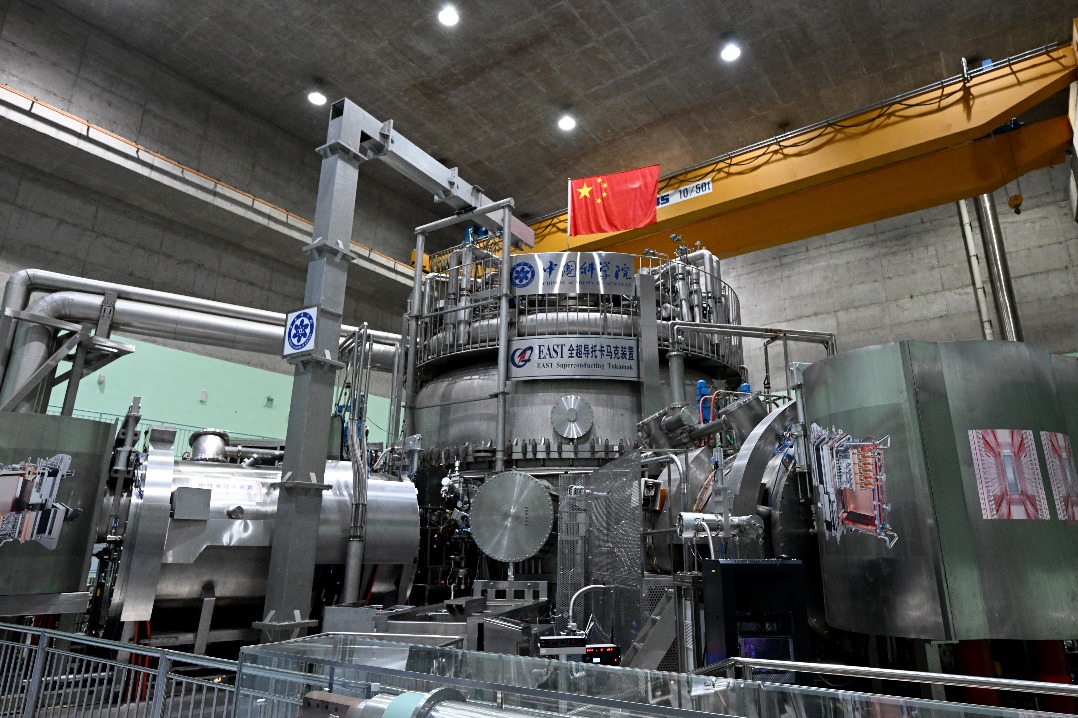
In a landmark achievement for nuclear fusion research, Chinese scientists have successfully surpassed the longstanding plasma density limit using the Experimental Advanced Superconducting Tokamak (EAST), China’s pioneering ‘artificial sun’ facility. This breakthrough, published in Science Advances on January 2, 2026, represents a critical advancement toward practical nuclear fusion energy.
The international research collaboration, led by the Institute of Plasma Physics at the Hefei Institutes of Physical Science (Chinese Academy of Sciences) in partnership with Huazhong University of Science and Technology and France’s Aix-Marseille University, has developed a revolutionary theoretical model explaining plasma-wall interactions. Their research identified radiation instability triggered by boundary impurities as the fundamental mechanism behind the previously impenetrable density barrier.
Tokamak devices, which use powerful magnetic fields to contain superheated plasma in a toroidal configuration, have long been constrained by this density limitation. When approaching this threshold, plasma would become unstable, escape magnetic confinement, and release dangerous energy bursts capable of damaging reactor components.
The research team’s innovative approach enabled experimental manipulation of plasma beyond conventional limits, guiding it into a previously theoretical ‘density-free zone.’ This marks the first experimental verification of such a stable high-density plasma state in tokamak history.
This scientific milestone provides both crucial theoretical understanding and practical methodology for achieving sustained high-density plasma operation—a fundamental requirement for viable fusion power generation. The breakthrough significantly advances prospects for developing clean, virtually limitless fusion energy by addressing one of the most persistent challenges in magnetic confinement fusion technology.