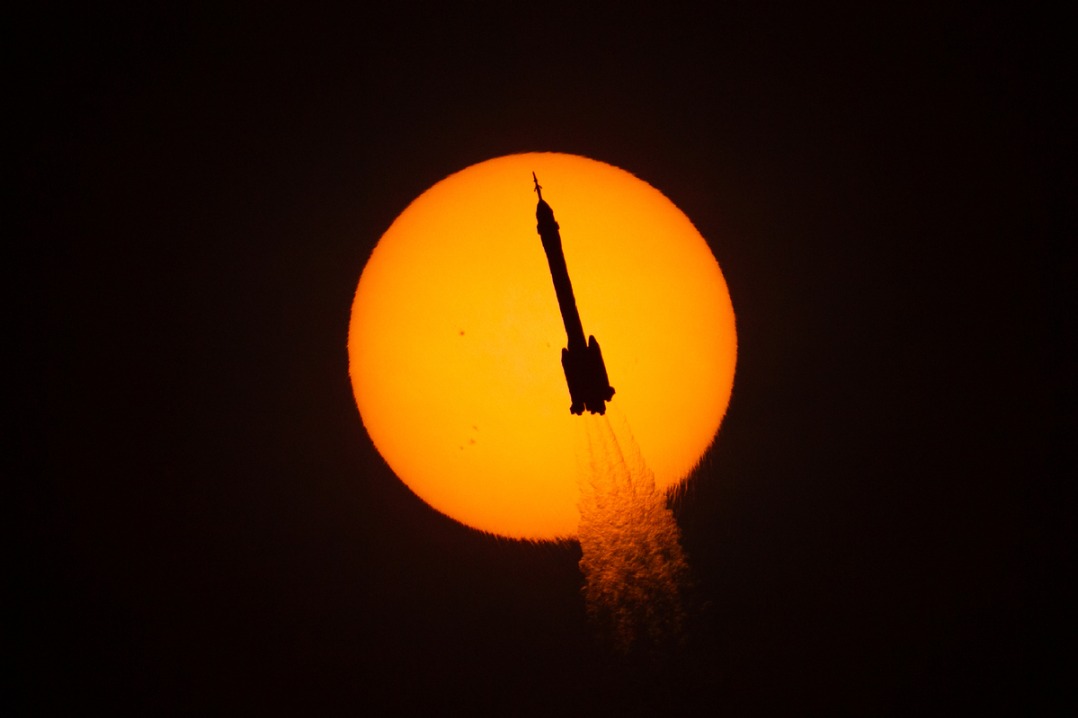
China’s space program concluded 2025 with unprecedented achievements, demonstrating remarkable capabilities in orbital operations and deep space exploration. The year witnessed two historic firsts: the successful execution of an emergency crew rescue mission and the launch of the nation’s inaugural asteroid sampling expedition.
The Tianwen-2 probe embarked on its decade-long mission on May 29, marking China’s first venture to collect samples from asteroid 2016HO3 before proceeding to study main-belt comet 311P. This pioneering mission aims to analyze the physical properties, composition, and internal structures of these celestial bodies, potentially revolutionizing our understanding of small planetary formation and evolution.
Orbital operations reached new heights of sophistication when the Shenzhou XX spacecraft developed critical viewport cracks from space debris impact shortly before its scheduled November return. In response, China executed two emergency procedures: the safe return of astronauts aboard the backup Shenzhou XXI spacecraft, and the rapid launch of unmanned Shenzhou XXII with repair equipment and supplies. This demonstrated unprecedented contingency response capabilities in human spaceflight history.
Scientific research aboard the space station yielded extraordinary results, including the creation of spinor Bose-Einstein condensates using all-optical traps, establishment of quantum simulation platforms cooling atoms to picokelvin temperatures, and successful breeding of three generations of fruit flies in microgravity. The Shenzhou XX mission additionally produced high-quality protein crystals with potential cancer therapy applications, achieved record-high materials science temperatures exceeding 3,100°C, and conducted groundbreaking colloid crystallization studies.
Lunar exploration advanced significantly with the return of experimental moon bricks after year-long space exposure, providing crucial data for future lunar construction. Analysis of Chang’e-6 far side samples revealed temperature differentials between the moon’s hemispheres, offering new insights into lunar geological evolution.
International collaboration expanded through February’s agreement with Pakistan for astronaut training, reinforcing China’s commitment to global space cooperation. These achievements establish strong foundations for China’s ambitious plans: crewed lunar landings by 2030 and establishment of the International Lunar Research Station by 2035.