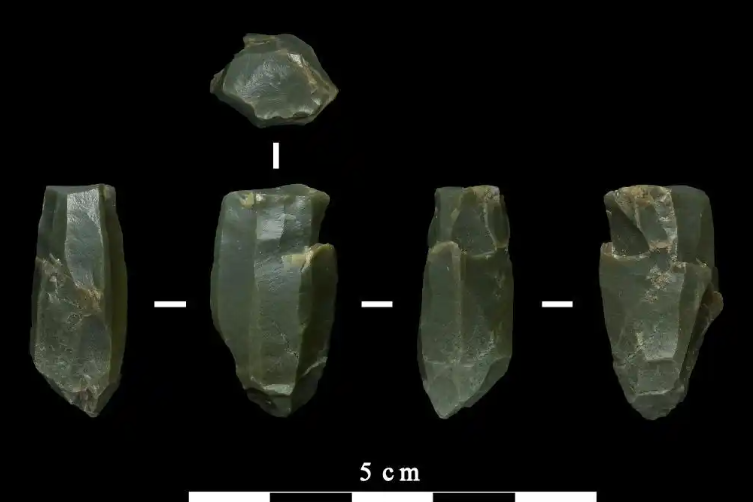
Chinese archaeologists have made a groundbreaking discovery on the eastern Qinghai-Tibet Plateau, unearthing the highest-altitude evidence of ancient human activity ever recorded in the region. The significant find, located near Tsungqen Co lake in Daocheng county at an extraordinary elevation exceeding 4,300 meters, provides revolutionary insights into early human migration patterns and adaptive capabilities in extreme environments.
The research team from Peking University and Sichuan Provincial Cultural Relics and Archaeology Research Institute published their detailed findings in the prestigious journal Palaeogeography, Palaeoclimatology, Palaeoecology. The Tsungqen Co site forms part of the renowned Piluo archaeological complex, previously recognized as China’s top archaeological discovery of 2021.
While the main Piluo site dates back over 200,000 years at 3,750 meters elevation, the newly discovered Tsungqen Co location surpasses it in altitude, with cultural layers dating approximately 12,000 years. Archaeologists excavated over 190 stone artifacts demonstrating sophisticated microlithic technology, indicating specialized adaptations to the high-altitude environment.
Dr. Zheng Zhexuan, lead archaeologist of the project, emphasized the site’s significance: “This was not merely a temporary camp but rather a habitation site revisited repeatedly. It demonstrates that ancient populations already utilized warmer climatic phases to establish settlements by highland lakes over ten millennia ago, showing remarkable adaptability to plateau conditions.”
The Qinghai-Tibet Plateau, often called the “Third Pole” due to its extreme elevation, low oxygen levels, and frigid temperatures, has long been considered challenging for human survival. This discovery represents a pivotal breakthrough in understanding how early modern humans in East Asia developed survival strategies under diverse ecological pressures.
Experts describe the site as a crucial “spatiotemporal key” that bridges critical gaps in the evidence chain of human activity on the “roof of the world.” Ongoing multidisciplinary research involving chronology and environmental archaeology aims to reconstruct a more precise understanding of ancient lifeways in this extreme environment, potentially rewriting chapters of human migration history.