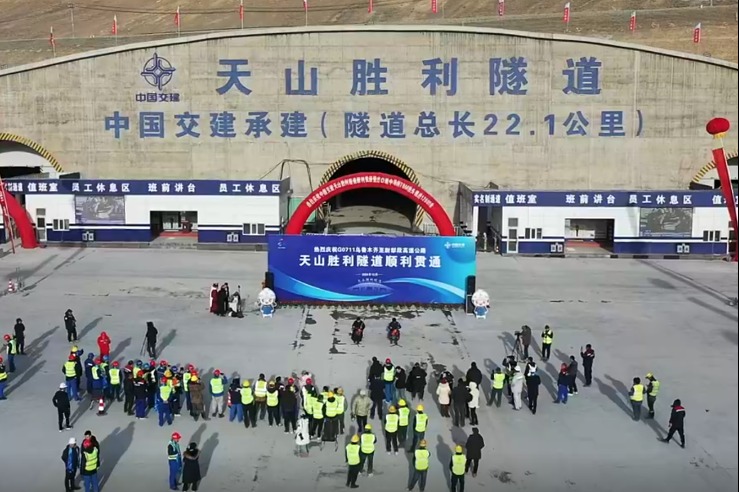
In a monumental infrastructure achievement, China’s Xinjiang Uygur Autonomous Region prepares to inaugurate a transformative 319.7-kilometer expressway by December’s end, featuring the world’s longest expressway tunnel that conquers the formidable Tianshan Mountains.
The centerpiece of this engineering marvel is the 22.13-kilometer Tianshan Shengli Tunnel, an unprecedented bore through the east-west mountain range that has historically divided northern and southern Xinjiang. This strategic corridor connects regional capital Urumqi, north of the mountains, with Yuli County in the Bayingolin Mongolian Autonomous Prefecture to the south through a complex network of 265 bridges and 17 tunnels constructed since 2019.
The transportation revolution will dramatically compress travel times across the region. The mountain crossing that once took hours will now require approximately 20 minutes through the Shengli Tunnel, while the journey from Urumqi to Korla—Bayingolin’s major urban center—will be slashed from seven hours to just three.
According to Guo Sheng, Party Secretary of Xinjiang’s Transport Department, this infrastructure breakthrough addresses persistent transportation bottlenecks that have hindered coordinated regional development for decades. The project represents significant technological innovation in constructing ultra-long highway tunnels under extreme high-altitude, cold-weather mountain conditions, establishing new benchmarks for similar challenging projects globally.
The enhanced connectivity promises substantial economic and tourism benefits. Liu Heping, head of Bayingolin’s tourism association, reports that local authorities, scenic sites, and hospitality providers are preparing for anticipated visitor surges to the prefecture’s renowned attractions including the UNESCO World Heritage-listed Bayanbulak National Nature Reserve, Bayanbulak Grassland, and Bosten Lake.
This expressway forms part of Xinjiang’s broader transportation modernization initiative. Several additional north-south transport projects commenced construction earlier this year, including the Yining-Aksu railway and the Kuitun-Dushanzi-Kuqa expressway. Over the past decade, Xinjiang has developed an integrated transport system spanning 9,557 kilometers of rail connections reaching all 14 prefecture-level regions and over 80% of county-level administrative areas.
By year’s end, Xinjiang’s total road network will extend approximately 237,000 kilometers, with nearly all county-level areas accessible via expressway or first-class highway. The region boasts comprehensive transportation access with paved roads, bus services, and postal coverage reaching every township and eligible administrative village. Complementing this ground transportation network, Xinjiang operates China’s highest number of regional airports (28) with 665 air routes, handles over half of China-Europe freight trains, and maintains 119 international road transport routes plus 37 international cargo air connections.