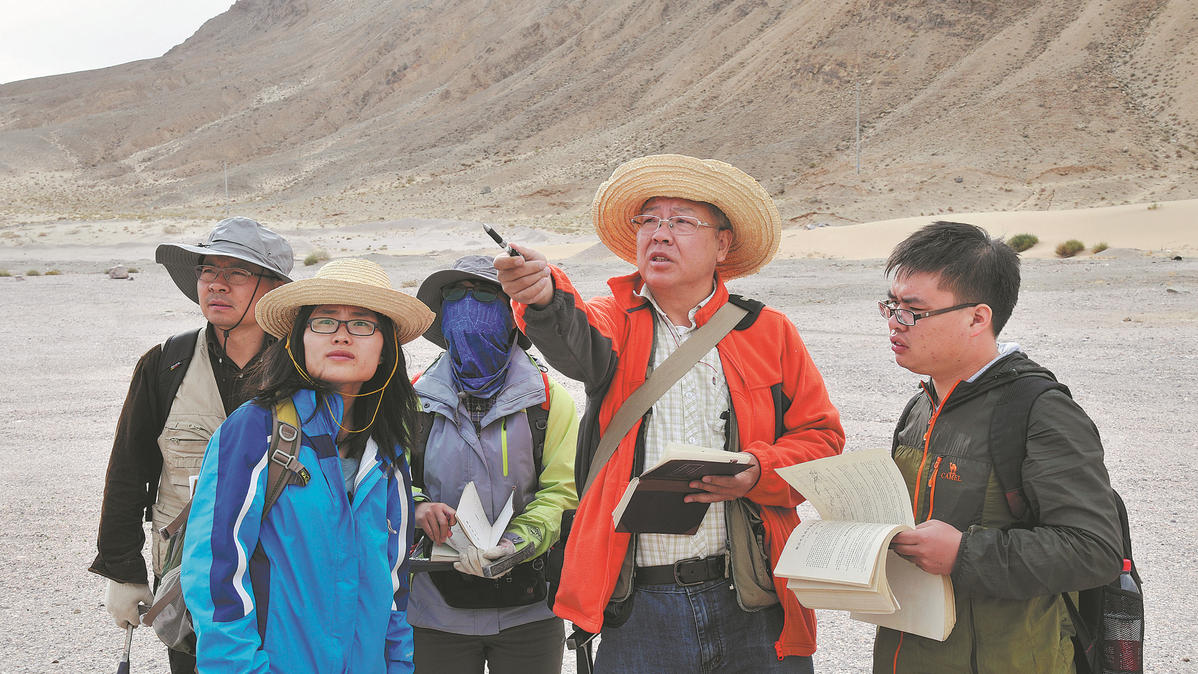
In a remarkable scientific journey that began with childhood mountain dreams, Professor Zhu Maoyan has revolutionized our understanding of early life on Earth, culminating in his recent election as an academician of the Chinese Academy of Sciences—China’s highest scientific honor. The world-renowned paleontologist, whose work recently earned a spot in Science magazine’s 2024 Top 10 Scientific Breakthroughs, has dedicated his career to unraveling the mysteries of multicellular life that predate the Cambrian explosion.
Zhu’s extraordinary path to paleontological prominence started in Wangjiang county, Anhui province, where a high school classmate’s casual remark about geologists climbing mountains daily sparked his imagination. This simple fascination led him to Changchun College of Geology in the 1980s, where he specialized in paleontology due to its connection to biology. His academic pursuit continued at the Nanjing Institute of Geology and Paleontology, where he began his professional research career studying the internationally significant Chengjiang fossils—518-million-year-old specimens that provide unprecedented insight into ancient marine ecosystems.
Fieldwork presented early challenges that tested Zhu’s determination. During his first expedition to Yunnan’s remote fossil sites, he endured arduous travel conditions and treacherous mountain terrain, once climbing a steep slope during a rainstorm with such intense focus that he used both hands and feet to secure his position while searching for fossils.
After advanced research in Germany as a visiting scholar at the Technical University of Berlin from 1997-1999, Zhu returned to China through the Chinese Academy of Sciences’ talent program. He established his own research team at the Nanjing Institute, where decades of systematic investigation have yielded transformative discoveries.
The team’s most significant breakthrough came when Zhu guided doctoral student Miao Lanyun in discovering over 200 multicellular eukaryote fossil specimens in North China’s Yanshan Mountain region. These 1.63-billion-year-old fossils pushed back the appearance of complex multicellular life by 70 million years, fundamentally altering scientific understanding of evolutionary timelines. This finding demonstrates that eukaryotes developed multicellularity much earlier than previously believed, challenging the assumption that they remained single-celled for approximately one billion years.
Zhu emphasizes that paleontology satisfies humanity’s fundamental curiosity about origins while encouraging international collaboration. ‘Our perspective is global,’ he notes, highlighting that each continent possesses unique fossil resources that require multinational cooperation to fully utilize.
Now 61, Zhu continues to lead research exploring three primary areas: extending the study of complex life to earlier periods, investigating life’s origins and potential extraterrestrial life, and deepening understanding of the Cambrian explosion. He encourages young scientists to follow their passions rather than external pressures, stating: ‘When you believe something is worth doing and have the interest to support it, you won’t feel it is arduous.’
With China’s increased investment in paleontological research and expanding museum infrastructure, Zhu anticipates continued growth in the field, inspiring new generations to pursue scientific curiosity about life’s deepest mysteries.