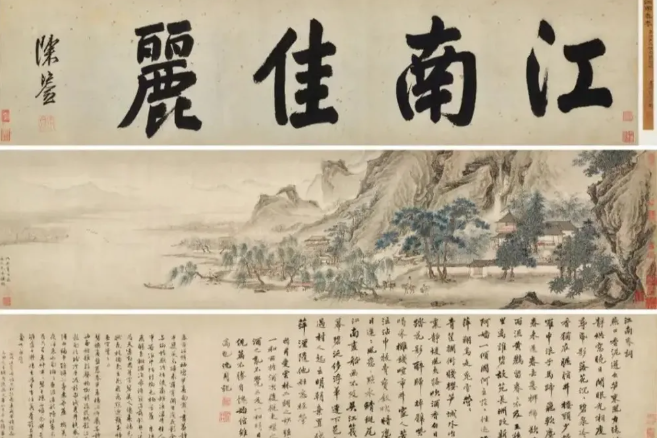
Nanjing Museum has produced archival documents claiming a disputed 16th-century landscape painting at the center of a major donation controversy was officially classified as forged decades ago. The revelation comes amid escalating legal battles with the descendants of renowned collector Pang Laichen (1864-1949), who donated 137 artifacts to the institution in 1959.
The conflict emerged when family members discovered ‘Jiangnan Spring’ – attributed to Ming Dynasty master Qiu Ying – was scheduled for auction in Beijing with an ¥88 million ($12.5 million) price tag. The painting was abruptly withdrawn after the Pangs protested, prompting investigations that revealed five artworks from their donation were missing from museum records.
According to documents presented by the museum, a 1961 expert panel determined ‘Jiangnan Spring’ was duplicated, with a second panel confirming its forged status in 1964. Records indicate the painting was subsequently transferred to Jiangsu Cultural Relics Store in the 1990s under then-prevailing collection management regulations, with a 2001 invoice showing its eventual sale for merely ¥6,800 as ‘A Copy of Qiu Ying’s Jiangnan Spring’.
Pang Shuling, the collector’s great-granddaughter, has filed a court enforcement application demanding full transparency regarding the transferred artifacts. ‘The donation made by my father to Nanjing Museum in 1959 are all precious works, they are not forged,’ she asserted.
The museum maintains it acted within historical guidelines, with attorney Zhang Han noting ownership transferred completely upon donation. However, family attorney Yin Zhijun argues donors retain right-to-know privileges regarding their contributions’ preservation.
Museology professor Pan Shouyong of Shanghai University contextualized the dispute: ‘People’s understanding of what a ‘cultural relic’ is has been constantly growing. It’s unfair to always use today’s guiding mindset to judge past deeds, but neither can we conceal a past blemish if we want to achieve more.’
The case highlights evolving standards in China’s cultural heritage management, particularly since the National Cultural Heritage Administration’s 2018 interim measures requiring donor consultation for deaccessioning procedures.