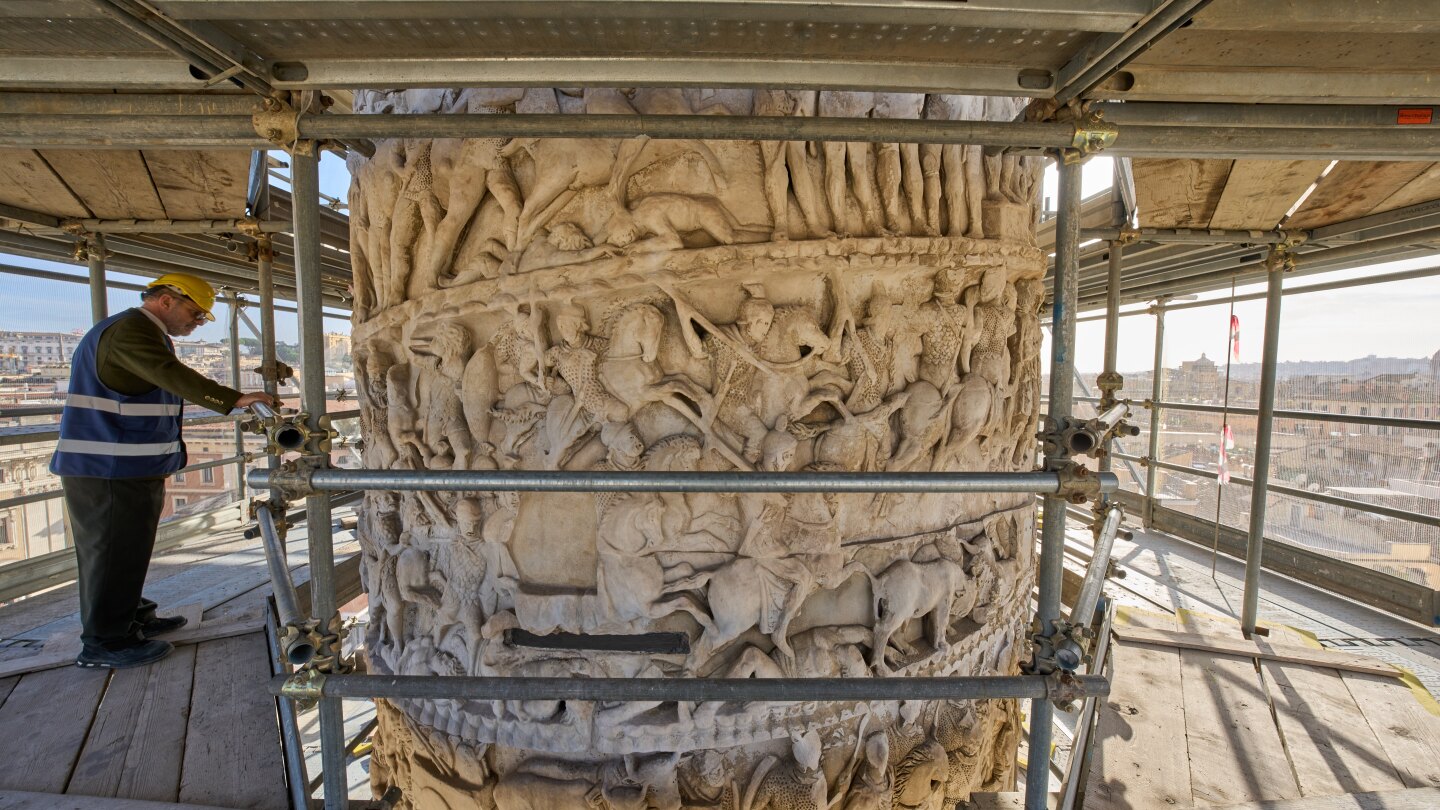
In an extraordinary fusion of ancient history and modern technology, restorers in Rome are employing advanced laser systems to cleanse the nearly two-millennia-old Column of Marcus Aurelius. The monumental restoration project, situated in the heart of the Italian capital adjacent to the prime minister’s office, represents a significant advancement in archaeological preservation techniques.
The 47-meter (154-foot) marble pillar, constructed between 180 and 193 AD, features an intricate spiral relief documenting the military campaigns of Emperor Marcus Aurelius. Unlike previous restoration efforts in the 1980s that utilized manual brushing methods, contemporary experts are implementing short-pulse laser technology that selectively removes centuries of accumulated pollution and biological growth while preserving the original marble surface.
Marta Baumgartner, director of restoration works, emphasized the technological superiority of the new approach: “The laser provides exceptional results with increased efficiency and, most importantly, demonstrates profound respect for the historical material and its surface layers.”
The elaborate bas-reliefs depict unflinching scenes from ancient warfare, including soldiers capturing women and children by their hair, decapitated enemies, and terrified prisoners with bound necks. These artistic representations have suffered from environmental damage including erosion, pollution from urban smog, and water infiltration that has compromised some facial features of the carved figures.
A team of 18 specialists employs a multifaceted approach combining laser technology with chemical applications, specialized sponges, and resin injections to address structural vulnerabilities. The sophisticated scaffolding system encircling the column provides unprecedented access to the upper sections, where figures gradually increase in size—an intentional artistic technique to enhance visibility from ground level.
Valentin Nitu, a project restorer, noted the narrative power of the column: “The artistic composition actively engages the viewer, compelling them to experience the story phase by phase with remarkably detailed scenes.”
Funded by a 2-million-euro allocation from the post-pandemic European recovery fund, the project includes the installation of new nocturnal illumination systems. Commencing in April, the comprehensive restoration is scheduled for completion in June, promising renewed visibility for one of Rome’s most significant historical monuments.