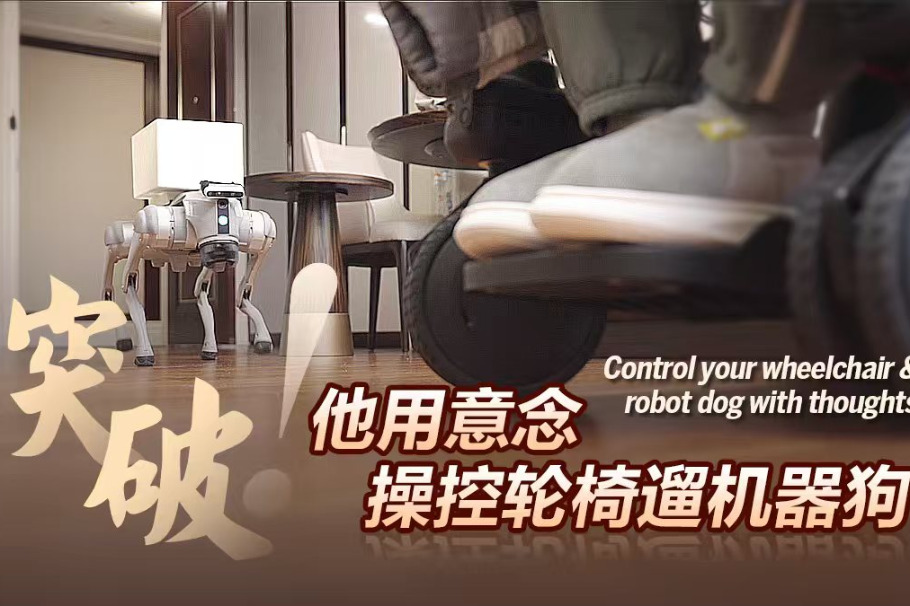
In a landmark demonstration of neurotechnology, a completely paralyzed Chinese patient has achieved unprecedented independence through an advanced brain-machine interface (BMI) system. The patient, a man in his thirties, successfully manipulated a power wheelchair and commanded a robotic assistance dog to retrieve deliveries using only neural signals.
The revolutionary BMI technology was surgically implanted in June 2025 through a collaboration between the Chinese Academy of Sciences’ Center for Excellence in Brain Science and Intelligence Technology and private sector partners. This sophisticated system translates neural activity into digital commands, enabling direct brain-to-device communication without requiring physical movement.
Clinical results demonstrate transformative improvements in daily living capabilities. The patient has reached levels of self-sufficiency, vocational engagement, and social interaction that were previously considered unattainable for individuals with high-level paralysis. This represents the most significant advancement in functional restoration for paralyzed patients since the development of neural prosthetics.
The technology’s successful real-world application signals a new era in assistive technologies and neurological rehabilitation. Medical experts highlight that this breakthrough extends beyond laboratory research, offering tangible solutions that dramatically improve quality of life for those with severe mobility impairments.
Researchers indicate that this achievement establishes new benchmarks for neural interface technology and paves the way for more sophisticated human-machine integration systems in the future.