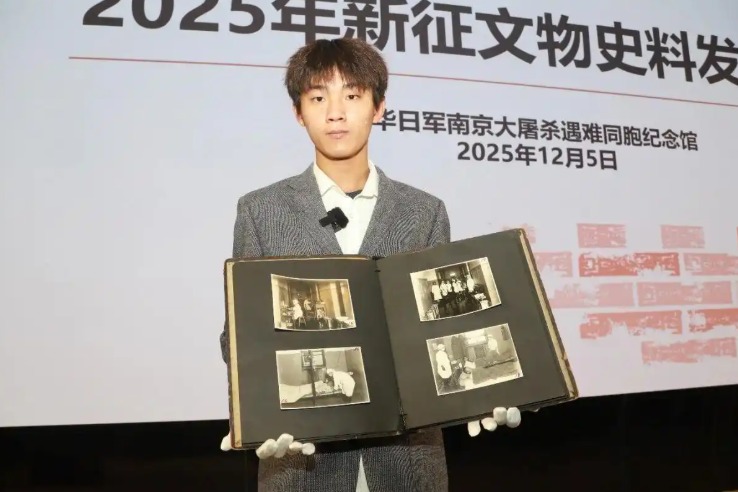
In an extraordinary act of historical preservation, 15-year-old Yu Ningpeng from Xuzhou, Jiangsu province has donated significant wartime artifacts to the Memorial Hall of the Victims in Nanjing Massacre by Japanese Invaders. The high school student, who began collecting historical items at age six, has dedicated nine years to assembling evidence countering Japanese right-wing attempts to distort invasion history.
The donated materials include two particularly revealing documents: a December 18, 1937 battlefield letter sent by a Japanese lieutenant to Fukushima prefecture, bearing a distinctive ‘Nanjing Fall Memorial’ postmark, and a photographic album from the Japanese military’s Hanami unit containing 44 rare images documenting a field hospital establishment in Tianjin.
The lieutenant’s correspondence vividly describes the capture of Nanjing: ‘Our destination, the capital Nanjing, was finally captured by us on the 13th. On the 17th, we held a grand entry ceremony for the military commander and received a review.’ Meanwhile, the photo album provides unprecedented visual evidence of military medical operations, showing hospital layouts, laboratory facilities, supply rooms, and patient wards.
Yu acquired these artifacts through secondary trading platforms at considerable personal expense, investing over 20,000 yuan without parental financial support. ‘All the expenses for the collection were earned through my own insight and knowledge,’ the teen collector revealed.
The donation ceremony on December 5 marked Yu’s seventh visit to the memorial hall since its 2007 reopening, though his first as an official donor. His contribution comes amid increased public engagement with historical preservation, as the museum has received 573 artifacts this year alone—a 30% increase over previous years.
Yu emphasizes that historical remembrance serves educational rather than retaliatory purposes: ‘Remembering history is not about perpetuating hatred, but about learning from it.’ The aspiring archaeologist advocates for Sino-Japanese youth exchanges grounded in historical accuracy, stating that friendship should not come at the expense of truth. His ultimate goal remains clear: ‘We must work hard to learn skills and make the country stronger so that historical tragedies do not repeat themselves.’