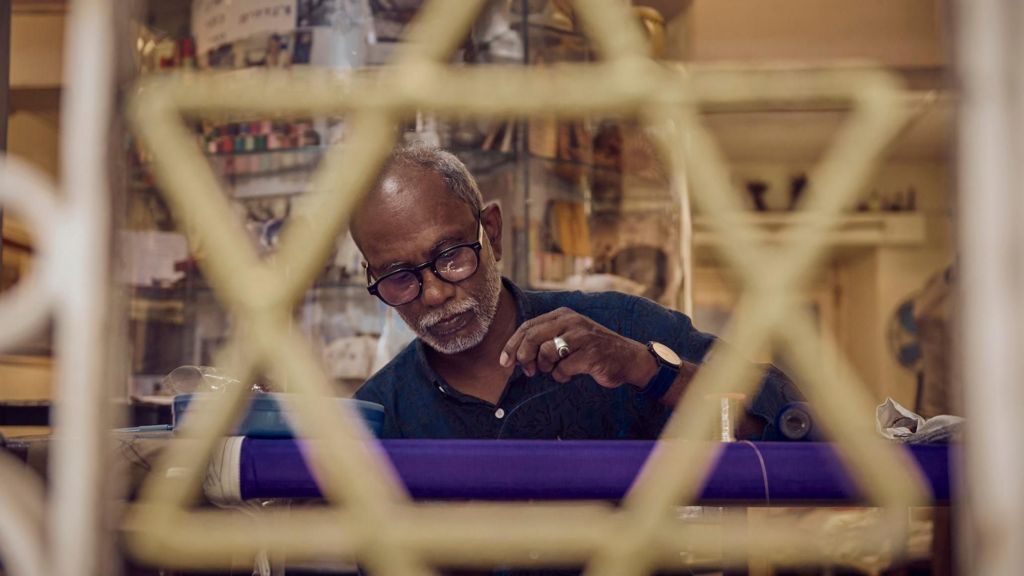
In the heart of Kochi’s historic Jew Town, where cobbled lanes echo with centuries of multicultural heritage, Thaha Ibrahim maintains an extraordinary cultural legacy. The 55-year-old Muslim embroidery artisan now operates what remains as the final Jewish embroidery shop in this southern Indian city—once known as the Queen of the Arabian Sea for its significance as a spice trade hub.
His establishment still bears the sign ‘Sarah Cohen’s Home,’ honoring the Jewish woman who became his mentor and surrogate mother. Their unconventional friendship defied religious and economic boundaries, spanning nearly four decades until Sarah’s death in 2019 at age 96. Thaha first began assisting in the shop in 2000, eventually taking full ownership according to Sarah’s final wishes.
The shop’s origins trace back to the early 1980s when Thaha, then a teenage school dropout selling postcards to tourists, encountered the Cohens by chance. Initially met with skepticism by Sarah, their relationship transformed when Thaha demonstrated natural talent for embroidery—a skill likely inherited from his tailor father. Under Sarah’s guidance, he mastered creating traditional Jewish items including kippahs (skullcaps), challah covers, and menorahs.
Jew Town itself tells a story of vanishing heritage. Once home to 2,500 Jews in the 18th century, the community has dwindled to a single remaining Jewish resident today. Jewish settlement in Kerala dates back 2,000 years during King Solomon’s reign, with later waves of Sephardic Jews arriving in 1492 fleeing Spanish persecution. These communities collectively became known as Cochin Jews, living under the protection of local rulers in what was historically a multicultural trading center.
The exodus accelerated after Israel’s establishment in 1948, with most families seeking better economic opportunities or marriage prospects abroad. Scholar Anna Zacharias notes that religious persecution was never a factor in multicultural Kochi, where Jews maintained their identity while integrating through speaking Malayalam and participating in local culture.
Thaha honors his promise to preserve Sarah’s legacy with profound respect for Jewish traditions. He closes the shop on Shabbat, lights the traditional Friday evening lamp despite being a practicing Muslim, and regularly visits Sarah’s grave at the Jewish cemetery. ‘To me, it’s not about religion but about humanity,’ he reflects—a testament to intercultural bonds that endure beyond religious divisions.