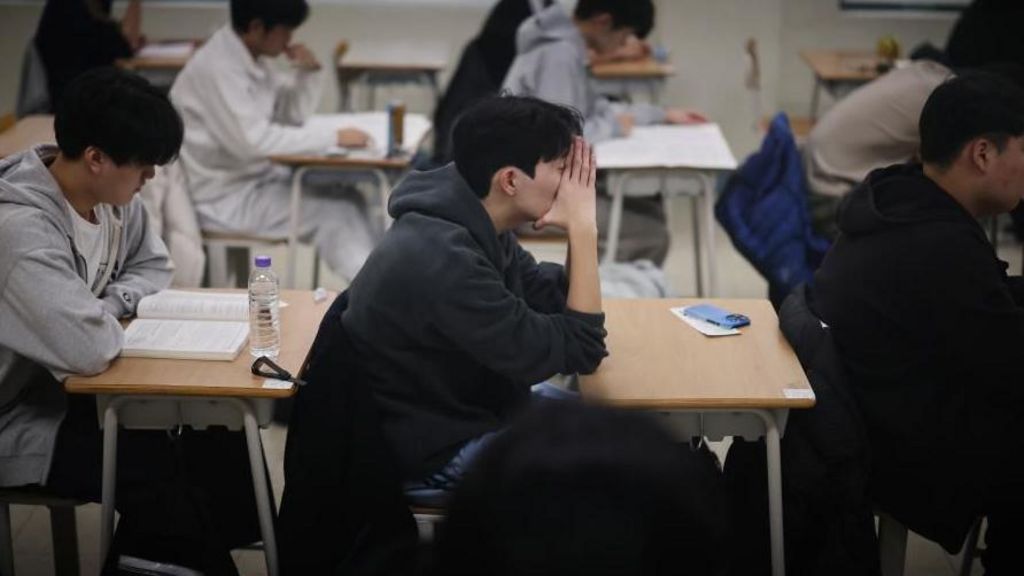
South Korea’s formidable college entrance examination, known as Suneung, has ignited intense national discourse following widespread criticism of its exceptionally challenging English section. The eight-hour academic marathon, administered annually in November, represents one of the world’s most demanding standardized tests, with profound implications for students’ university admissions, career trajectories, and social standing.
The recent examination’s English component provoked such significant controversy that Oh Seung-geol, the chief administrator of Suneung, resigned from his position. He publicly acknowledged that the test’s difficulty level was inappropriate and expressed regret that the assessment fell short of expectations despite undergoing multiple review stages.
Among the most contentious questions was one involving complex gaming terminology that required students to identify where a specific sentence should be inserted within a dense philosophical paragraph about virtual reality perception. Another question drew from Immanuel Kant’s legal philosophy, pushing the boundaries of what constitutes appropriate testing material for secondary education.
The gaming terminology question, worth three points, presented students with a technical excerpt from Steve Swink’s game design book Game Feel. Many educators and students criticized the question’s phrasing as unnecessarily convoluted, with some online commentators describing it as fancy smart talking that failed to effectively communicate concepts.
Statistical evidence underscores the examination’s increased difficulty, with only 3% of test-takers achieving the highest grade in English this year compared to 6% in the previous administration. Students reported spending excessive time deciphering questions where answer choices appeared remarkably similar, creating significant uncertainty during the testing process.
Educational experts remain divided on the examination’s appropriate difficulty level. Professor Jung Chae-kwan of Incheon National University, formerly involved with Suneung’s administration, contends that the test doesn’t measure English proficiency but rather rewards test-taking strategies. He argues that this approach renders the material educationally useless, as teachers increasingly focus on examination tricks rather than language acquisition.
Conversely, Professor Kim Soo-yeon from Hankuk University of Foreign Studies maintains that the specialized passages legitimately assess students’ readiness for university-level comprehension. The intentionally challenging content, she suggests, effectively evaluates whether students can handle the complex material they will encounter in higher education.
Beyond academic debates, Suneung represents a cultural phenomenon that brings South Korea to a virtual standstill each November. Construction halts, flight schedules adjust, and military training suspends to create optimal testing conditions. Parents frequently participate in religious ceremonies, lighting candles at Buddhist temples to pray for their children’s success in this high-stakes assessment that many students begin preparing for from early childhood through extensive cram school attendance.
The examination’s administrative leadership has proven notably unstable, with only four of twelve Suneung chiefs completing their full three-year terms since the test’s inception in 1993. While previous resignations typically resulted from factual errors in test questions, Mr. Oh’s departure marks the first instance of resignation primarily attributable to examination difficulty concerns.