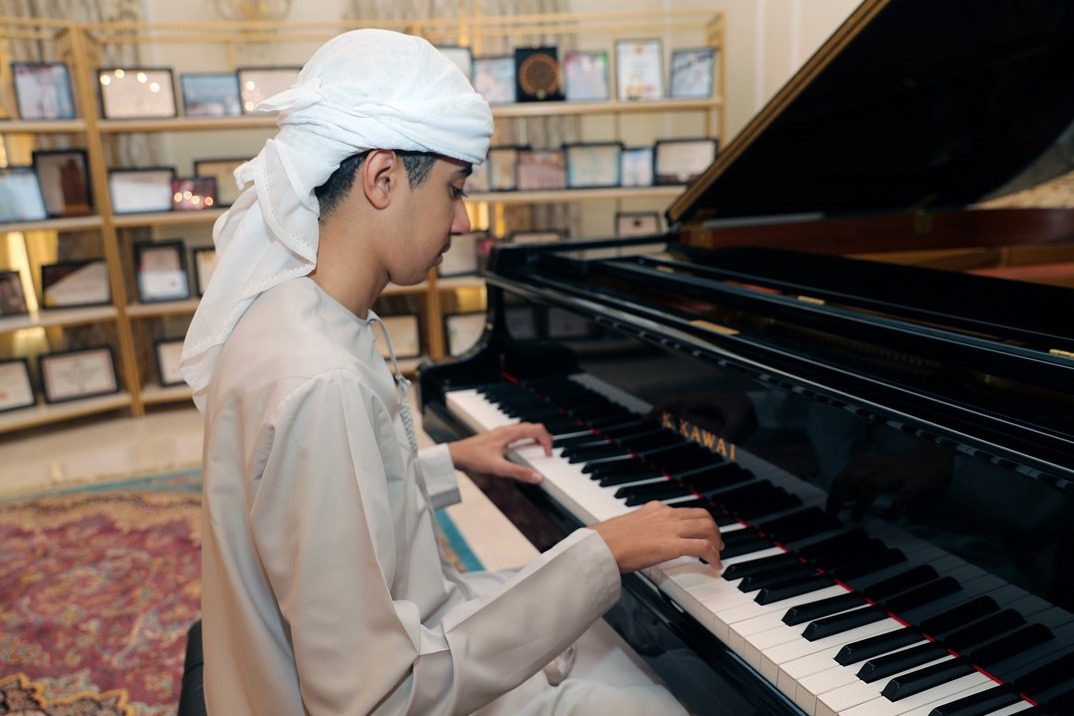
ABU DHABI, UAE — At just fifteen years old, Ahmed Al Hashemi has transformed his neurological difference into an extraordinary musical gift, using the piano as his primary means of communication with the world. Diagnosed with autism, Al Hashemi discovered early that traditional verbal expression presented challenges, but musical communication came with remarkable fluency.
His extraordinary journey began at age seven when he spontaneously played “Happy Birthday” on a piano after hearing the melody only once. This moment revealed his rare perfect pitch ability—the capacity to identify and reproduce any musical note without reference. His mother immediately recognized this exceptional talent and began nurturing his musical development.
Today, Al Hashemi has evolved into an internationally recognized composer and performer, receiving prestigious honors including the UNESCO Award and Mother Teresa Award for his musical contributions. Rather than viewing autism as a limitation, he embraces it as a unique perceptual lens that shapes his compositional style and emotional expression.
“The piano enables me to communicate feelings that I might not articulate verbally,” Al Hashemi explained. “Each note carries specific meaning, and I utilize music as my authentic voice.”
One of his most personally significant compositions, “A Day Without You,” emerged as an emotional response to his brother’s departure for military service. This piece demonstrated music’s capacity to convey complex emotions that words might fail to express adequately.
The young musician values both the connection with live audiences during performances and the solitary creative process of composition. He describes composing as “deeply personal—where I can express myself without limitations,” sometimes beginning with an emotion that transforms into sound, other times developing melodic ideas that emerge spontaneously.
Al Hashemi credits his mother’s unwavering belief in his abilities as fundamental to his success, acknowledging her dedication in finding appropriate teachers and opportunities that have fostered his musical growth. His story stands as a powerful testament to how artistic expression can transcend conventional communication barriers and create meaningful human connections.