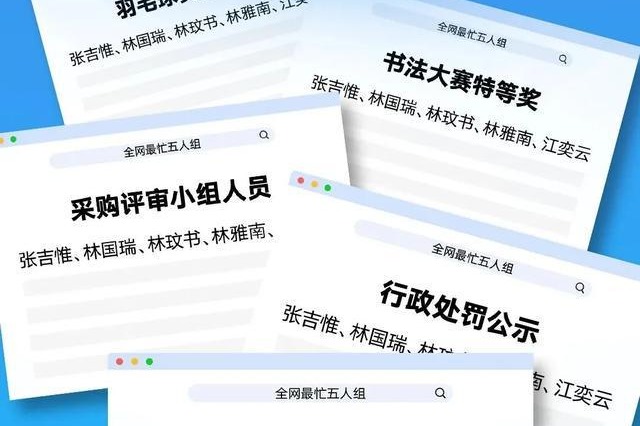
Chinese authorities have initiated nationwide investigations following the revelation that multiple government documents contained fabricated names directly copied from an online database, exposing systemic flaws in bureaucratic oversight mechanisms.
The scandal emerged when five names—Zhang Jiwei, Lin Guorui, Lin Wenshu, Lin Yanan, and Jiang Yiyun—appeared as expert evaluators for a major government procurement project in Hubei province. Astute internet users discovered these names matched, in identical sequence, the top entries from Baidu’s widely circulated ‘10,000 Common Chinese Names’ database.
Subsequent investigations revealed these fictitious identities have been systematically reused across China in various official contexts since at least 2019. The names have appeared as recipients of university grants in Zhejiang, violators of minor street regulations in Liaoning, and even winners of cultural competitions, earning them the unofficial title of ‘the internet’s five busiest people.’
Legal experts have raised serious concerns about the practice. Huang Dong, a Guangzhou-based commercial litigation lawyer, told China Daily that using fabricated names in official procedures constitutes multiple legal violations, including breaches of China’s Government Procurement Law and Administrative Penalty Law. He warned that responsible officials could face disciplinary action for dereliction of duty and potentially criminal charges for bid rigging if the practice concealed collusive tendering.
State media commentary has characterized the scandal as symptomatic of deeper ‘formalism’ within bureaucracy, where procedures are performed for appearance rather than substance. Professor Liu Dongchao of the National Academy of Governance suggested the phenomenon reflects an overly complex administrative system that prioritizes procedural compliance over substantive outcomes, creating incentives for fraudulent paperwork.
Multiple local governments have canceled affected projects, issued public apologies, and pledged accountability. Reform advocates are calling for implementation of verifiable authenticity standards, independent third-party reviews for major projects, and increased use of AI and big data to detect anomalies in public documentation.