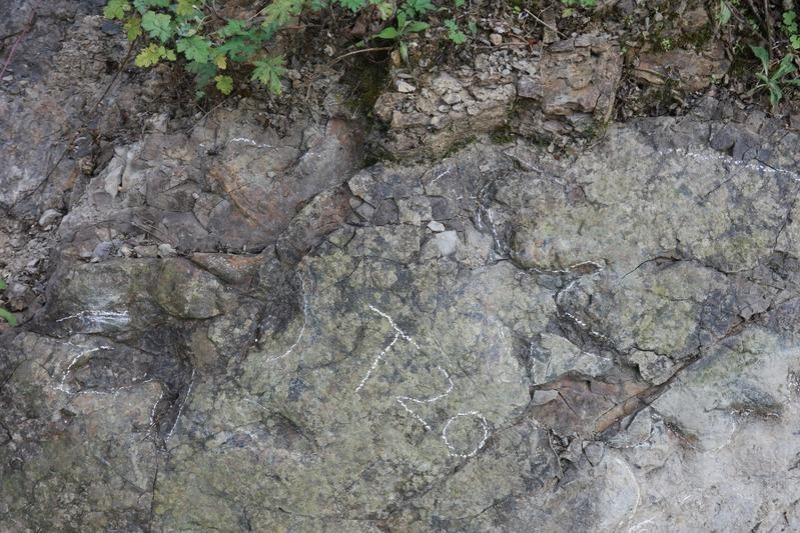
Paleontologists have made a significant discovery in Southwest China’s Sichuan province, unearthing a remarkable collection of prehistoric footprints dating back approximately 200 million years. The fossilized tracks, located on a rock wall in Dujiangyan city, were initially spotted by an observant hiker last month before being formally authenticated by a scientific team.
Led by Associate Professor Xing Lida from China University of Geosciences (Beijing), the research team confirmed the presence of more than 20 distinct vertebrate footprints representing multiple species from the Late Triassic period. This groundbreaking finding marks the first documented occurrence of dinosaur footprints in the Dujiangyan region.
The assemblage includes diverse track types, ranging from theropod impressions of varying sizes—attributed to carnivorous dinosaurs—to distinctive chirotherian-type tracks characterized by their hand-like appearance, typically associated with early archosaur reptiles.
Professor Xing emphasized the site’s exceptional scientific value, noting that “at least four distinct stratigraphic layers preserve these footprints, indicating sustained dinosaur activity in this area over an extended geological timeframe.”
Complementing the fossilized tracks, researchers discovered petrified wood specimens nearby, including both fallen logs and upright stumps preserved in their original positions. These botanical remains provide crucial contextual information about the Triassic ecosystem that once thrived in this region.
Jiang Shan, a researcher at Zigong Dinosaur Museum, highlighted the discovery’s importance for understanding dinosaur evolution in East Asia, stating that these well-preserved impressions offer invaluable insights into the early diversification and behavioral patterns of dinosaurs in what is now modern China.