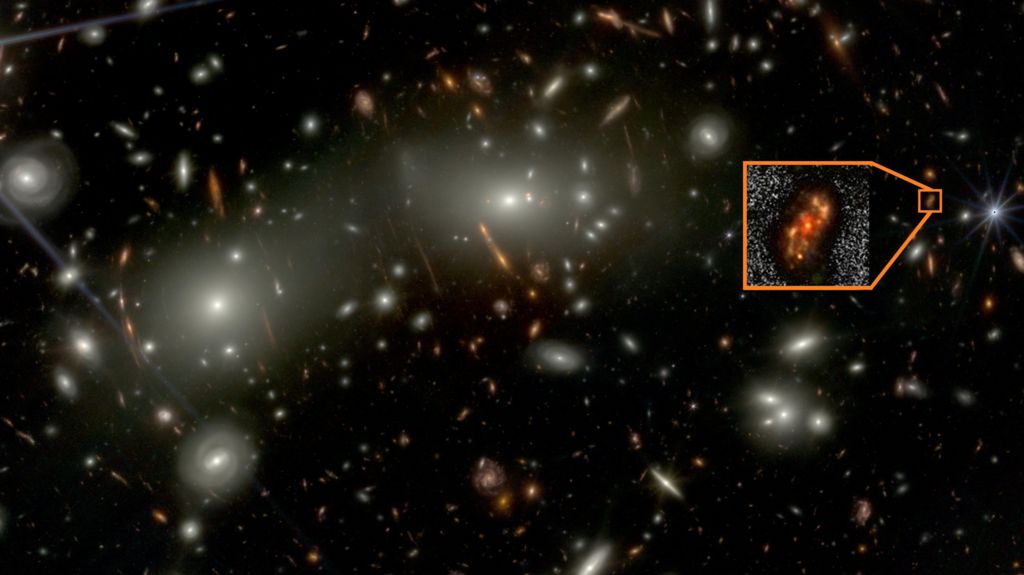
A groundbreaking discovery by Indian astronomers using the James Webb Space Telescope (JWST) has revealed a fully-formed spiral galaxy dating back to when the universe was merely 1.5 billion years old, fundamentally challenging existing models of early galactic evolution. This cosmic structure, named Alaknanda after a Himalayan river, exhibits symmetrical arms and a distinct central bulge remarkably similar to modern spiral galaxies like our Milky Way, despite existing during the universe’s infancy.
The research team led by PhD candidate Rashi Jain and Professor Yogesh Wadadekar from Pune’s National Centre for Radio Astrophysics identified the galaxy while analyzing approximately 70,000 celestial objects in JWST data. Alaknanda spans approximately 30,000 light-years in diameter and contains an estimated 10 billion solar masses of stars, representing approximately one-third the size of our Milky Way but with a star formation rate 20-30 times greater.
Published in the prestigious journal Astronomy and Astrophysics, these findings contradict prevailing astronomical theories suggesting the early universe was predominantly populated by irregular, chaotic galactic structures. The presence of such a sophisticated spiral formation merely 1.5 billion years after the Big Bang indicates the universe achieved structural maturity much earlier than previously believed.
‘This galaxy had to assemble tremendous stellar mass and develop complex spiral architecture within just a few hundred million years—an incredibly rapid timeline by cosmic standards,’ Professor Wadadekar explained. The discovery suggests current models may significantly underestimate the speed and complexity of galactic evolution in the universe’s formative epochs.
The researchers plan to conduct follow-up observations using both JWST and the ALMA observatory in Chile to investigate the mechanisms enabling such rapid spiral arm formation. As light from Alaknanda has traveled 12 billion years to reach Earth, astronomers are essentially observing the galaxy’s ancient state, with its current condition remaining unknown until future light arrives.
This discovery adds to growing evidence from JWST observations that the early universe contained more sophisticated structures than previously theorized, prompting potential revisions to our understanding of cosmic dawn and galactic development processes.