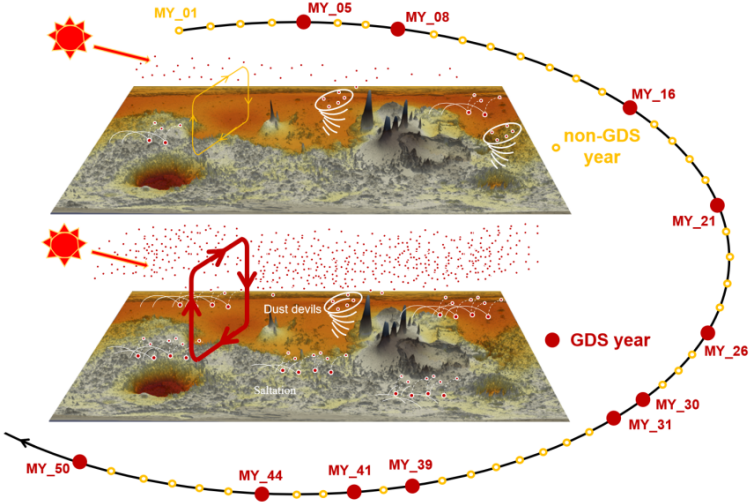
Chinese scientists have made a monumental leap in planetary science by successfully completing the first comprehensive simulation of Mars’ complex dust cycle. The breakthrough comes from researchers at the Institute of Atmospheric Physics, Chinese Academy of Sciences, who employed their independently developed next-generation Mars general-circulation model called GoMars.
The research, detailed in the prestigious journal Advances in Atmospheric Sciences, represents a critical advancement in understanding the behavior of atmospheric dust on the Red Planet. This achievement establishes a fundamental foundation for reliable Martian weather forecasting and long-term climate projections, addressing what has historically been one of the most challenging aspects of Martian atmospheric modeling.
Mars, frequently described as Earth’s closest planetary relative, presents severe environmental challenges including an extremely thin atmosphere, intense radiation levels, and violent dust storms. These planet-wide dust events, which can emerge without warning, constitute extreme weather phenomena that dramatically influence annual climate variations on Mars.
The research team conducted an extensive 50-Martian-year dust cycle simulation, enabling GoMars to replicate the complete life cycle of airborne dust particles. Despite limitations in existing observational data—which suffers from significant gaps in temporal continuity, spatial coverage, and resolution—the numerical model effectively fills critical knowledge voids.
In validation tests, researchers compared GoMars’ surface wind-stress dust lifting flux against established models including MarsWRF. The results demonstrated strong agreement between models regarding both seasonal timing and geographic patterns of dust activity.
Remarkably, GoMars demonstrated capability to spontaneously generate simulated planet-encircling dust storms, accurately identifying their initiation dates, epicenters, and transport pathways. These simulations align closely with actual observational data from specific Martian years, despite the sparse nature of available measurements.
Looking forward, the scientific team plans to integrate Martian water cycle dynamics into the model to examine intricate interactions between dust and water vapor. The ultimate objective involves transforming GoMars into an operational system that will incorporate real-time data from China’s upcoming Tianwen 3 mission, potentially enabling daily weather briefings for future Martian exploration activities.