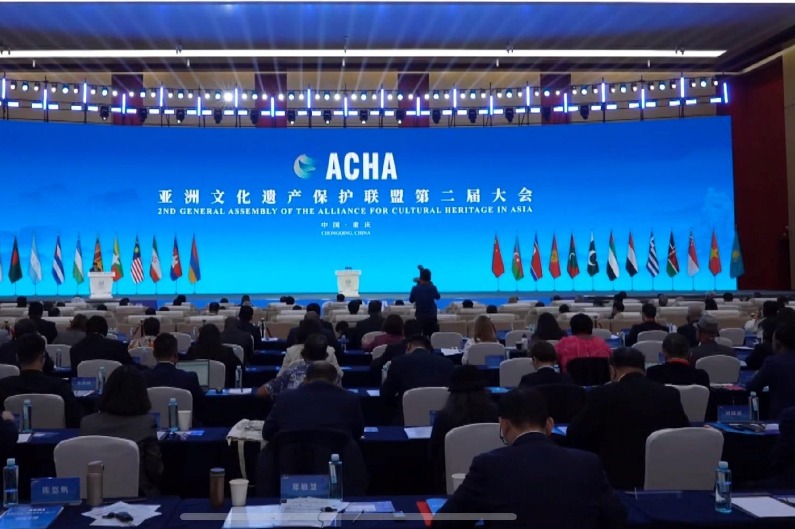
A transnational initiative dedicated to safeguarding Asia’s cultural treasures is capturing worldwide interest as it expands its global footprint and deepens international collaboration. The Alliance for Cultural Heritage in Asia, initially established in 2021, has evolved into a significant force in heritage conservation, attracting participation from diverse nations beyond the Asian continent.
During its recent second general assembly and third council meeting in Chongqing, the alliance convened over 200 specialists and representatives from 33 countries and international organizations. The gathering served to evaluate progress and chart future directions for the collaborative framework.
Rao Quan, Director of China’s National Cultural Heritage Administration, emphasized the alliance’s growing influence: “We are pleased to observe how the alliance has transcended geographical limitations and amplified its global impact. It facilitates not only intra-Asian cultural exchange but also fosters genuine dialogue between Asia and other world regions.”
The alliance has generated substantial practical outcomes since its inception, enabling advancements in ancient civilization research, collaborative archaeological excavations, historical site rehabilitation, and museum professional development. China alone has implemented 11 heritage preservation and restoration initiatives with nations including Cambodia, Uzbekistan, Myanmar, Nepal, Kyrgyzstan, and Kenya, while conducting 49 joint archaeological investigations with 28 countries internationally.
Notable projects include the Sino-Uzbek collaboration restoring Khiva’s ancient city to its former vitality and ongoing archaeological research between China and Saudi Arabia at al Serrian, a port ruin site near Mecca that reveals new insights about the ancient Maritime Silk Road.
Myanmar’s Vice-Minister of Religious Affairs and Culture, Nu Mra Zan, highlighted the tangible benefits of international cooperation, citing Chinese assistance following earthquake damage to Mandalay’s historical monuments. “This demonstrates how international collaboration helps address our challenges,” she noted. “Our experiences confirm that cooperative efforts yield optimal outcomes.”
The Chongqing Consensus emerged from the assembly, advocating enhanced regional cooperation to address shared risks, increased application of scientific and technological solutions, and mutual learning to advance collaborative development.
Significantly, the alliance welcomed new participants including Greece, Kenya, Cuba, and Malaysia, bringing total membership to 16 member states, four partner states, and four observer states. Despite its European location, Greece recognizes shared values with the alliance, as articulated by Despoina Zernioti of Greece’s Corfu Museum of Asian Art: “Greece—a culture with global influence—shares the alliance’s commitment to protecting, understanding, and promoting cultural heritage.”
Concurrently, Egypt and China signed agreements strengthening collaboration in world heritage nomination, management, and conservation, signaling deeper future cooperation in heritage documentation, artifact preservation, site management, capacity building, and risk mitigation.