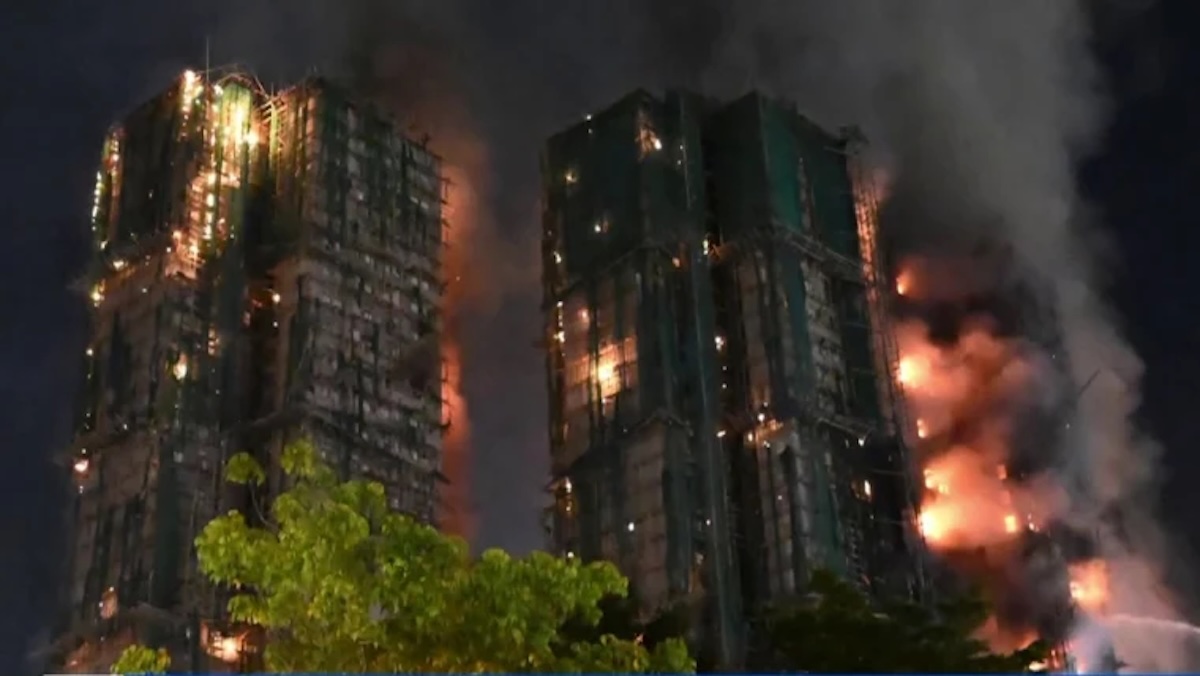
A catastrophic high-rise fire in Hong Kong has resulted in 83 confirmed fatalities with approximately 300 individuals still unaccounted for, marking the territory’s deadliest building fire since the 1996 Garley Building disaster. The blaze rapidly spread through a large residential complex via burning bamboo scaffolding, intensified by strong winds, ultimately highlighting fundamental vulnerabilities in high-rise evacuation protocols.
This tragedy underscores a critical urban safety dilemma: evacuating densely populated skyscrapers during emergencies presents extraordinary challenges that combine physical infrastructure limitations with complex human behavioral factors. Unlike routine fire drills where descent speeds average 0.4-0.7 meters per second, actual emergency conditions dramatically reduce movement efficiency. During the 9/11 attacks, documented evacuation speeds frequently dropped below 0.3 m/s, with similar patterns observed in the 2010 Shanghai high-rise fire where nearly half of elderly survivors reported significant mobility deterioration.
Three primary factors compound evacuation difficulties: physical fatigue during extended vertical descent, congestion at stairwell merging points, and variable mobility across diverse populations. Older adults, individuals with physical limitations, and family groups moving collectively substantially reduce overall flow rates. Visibility degradation due to smoke infiltration further impedes progress, as experimental studies confirm reduced lighting conditions significantly slow stairwell movement.
Human behavior introduces additional complications. Most residents don’t respond immediately to alarms, instead seeking confirmation through multiple cues—visual smoke detection, auditory signals, or social verification—before initiating evacuation. This validation process, while psychologically understandable, consumes precious minutes during critical early stages. Family coordination and belongings collection further delay response times.
Urban resilience experts Professors Milad Haghani (University of Melbourne), Erica Kuligowski (RMIT University), and Ruggiero Lovreglio (Massey University) argue that modern skyscraper safety requires integrated solutions beyond conventional stairwell dependence. Refuge floors—specially designed fire-resistant staging areas—allow evacuees to rest, transfer between stairwells, or await assisted evacuation. Fire-engineered elevators with pressurized shafts and backup power systems provide complementary vertical transportation when stairwells become impractical for vulnerable populations.
The Hong Kong catastrophe serves as a sobering reminder that as global urbanization accelerates toward vertical expansion, evacuation infrastructure must evolve beyond twentieth-century paradigms. Combining stairwells, refuge floors, and protected elevators creates redundant safety systems that acknowledge both human physiological limitations and behavioral realities during extreme stress conditions.