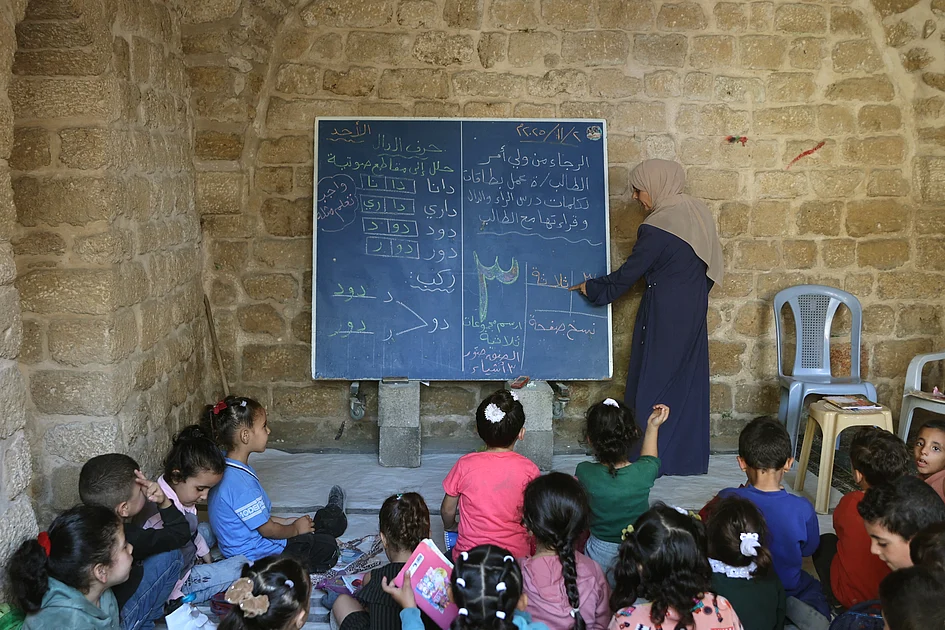
In the aftermath of the Israel-Hamas war, Gaza’s children are returning to makeshift classrooms, but the reality is far from normal. With 97% of Gaza’s schools damaged, many requiring full reconstruction, the educational landscape is in shambles. Eleven-year-old Layan Haji, who dreams of becoming a doctor, walks through the ruins of Gaza City to attend a temporary school set up in a battered building. ‘I walk for half an hour at least. The streets are devastated, full of ruins… It is difficult and sad,’ she says, yet she remains hopeful about resuming her studies. Haji is one of 900 students at the Al-Louloua al-Qatami school, which has opened its doors to provide education for the first time since the war began. However, the lack of basic supplies like books, notebooks, and even chairs poses significant challenges. Sixteen-year-old Said Sheldan, who has been displaced multiple times, shares similar struggles. ‘I don’t have books, notebooks, pens or a bag. There are no chairs, electricity or water — not even streets,’ he laments. The war has forced many children into ‘heavy labour’ to support their families, collecting firewood, fetching water, and standing in long queues for food. To address the psychological trauma, schools have adopted innovative teaching methods, such as using games and extracurricular activities. Despite these efforts, the scale of the crisis is immense. According to the UN, over 25,000 children have joined temporary learning spaces, but this is a fraction of the 758,000 students in Gaza. International initiatives, like Qatar’s Education Above All Foundation, are providing support, but the road to recovery is long. ‘Education is facing its most critical period,’ says Hazem Abu Habib, a local initiative leader. Before the war, Gaza was ‘completely free of illiteracy,’ but now, the future of its children hangs in the balance.