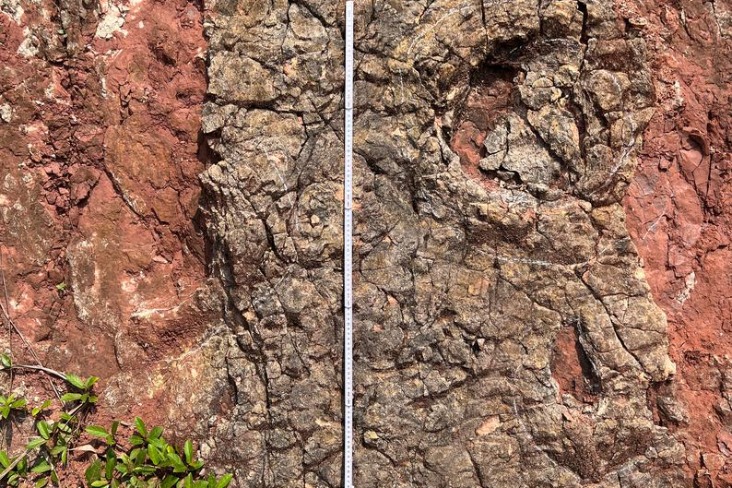
An international team of scientists from China, Germany, and the United States has made a groundbreaking discovery in Wucha village, Renhuai city, located in Southwest China’s Guizhou province. They have identified a significant collection of dinosaur footprints dating back to the Early Jurassic period. The findings, published in the Journal of Asian Earth Sciences, reveal that the area was once a lakeshore sandbar environment, ideal for various dinosaur groups. This discovery is particularly notable as the Renhuai area is already recognized as a crucial region for Early Jurassic dinosaur fossils in southern China. While previous findings in the area have included numerous sauropod and theropod tracks, this new discovery provides a rare systematic record of multiple dinosaur groups coexisting. Between 2020 and 2024, researchers from Guizhou University and China University of Geosciences (Beijing), among other institutions, discovered several vertebrate track sites in and around Wucha Village. According to Xing Lida, an associate professor at China University of Geosciences (Beijing), the Wucha track assemblage offers a comprehensive record of the coexistence of basal sauropodomorphs, sauropods, theropods, and basal ornithischians. Among the findings, the largest sauropod track measures 60 centimeters, consistent with Early Jurassic sauropod tracks commonly found in the Sichuan Basin. Some of the small basal ornithischian footprints show stride lengths of only 6 to 7 centimeters but relatively large step lengths, suggesting the dinosaurs were running. One set of two-digit footprints has particularly intrigued the research team. They believe these tracks were likely made by tridactyl dinosaurs while running or kicking, leaving only two-digit impressions, rather than being made by true two-digit dinosaurs. This finding suggests that under certain conditions, tridactyl dinosaurs can leave ‘two-digits-like’ impressions, which have important implications for identifying early deinonychosaur tracks and provide a new reference for interpreting similar ‘suspected two-digits prints’ worldwide, said Xing. This new discovery enriches the study of Early Jurassic dinosaur fauna in Guizhou. As more track sites are explored, the Renhuai area is expected to become a key window for researching dinosaur activity in China during the Early Jurassic period. The discovered footprints have been preserved at their original sites.