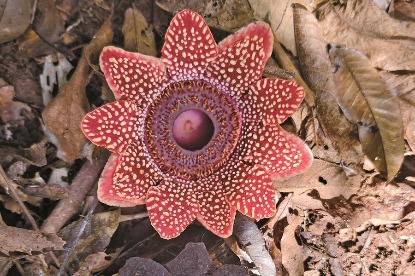
The elusive Sapria himalayana, a rare holoparasitic flowering plant, has once again entered its blooming period in the Mengla Nature Reserve Rainforest, located in Yunnan province’s Xishuangbanna Dai autonomous prefecture. This marks the third consecutive year the plant has been observed flowering in the area, according to local forest rangers. The plant, classified as a second-class nationally protected species, sporadically emerges from the humus layer of primary rainforests and grows directly from the roots of its host plant, Tetrastigma. Sapria himalayana, the only species of the Rafflesiaceae family found in China, lacks stems, roots, or leaves and cannot perform photosynthesis. It relies entirely on nutrients from its host plant and blooms only during its reproductive period from September to December each year. The consistent appearance of this rare plant underscores the ecological integrity of the Mengla Nature Reserve. Found exclusively in Yunnan and Motuo county in the Xizang autonomous region, Sapria himalayana remains exceptionally rare in China. Due to the absence of established conservation or cultivation technologies for parasitic plants, in situ conservation is the primary method for preserving its population.