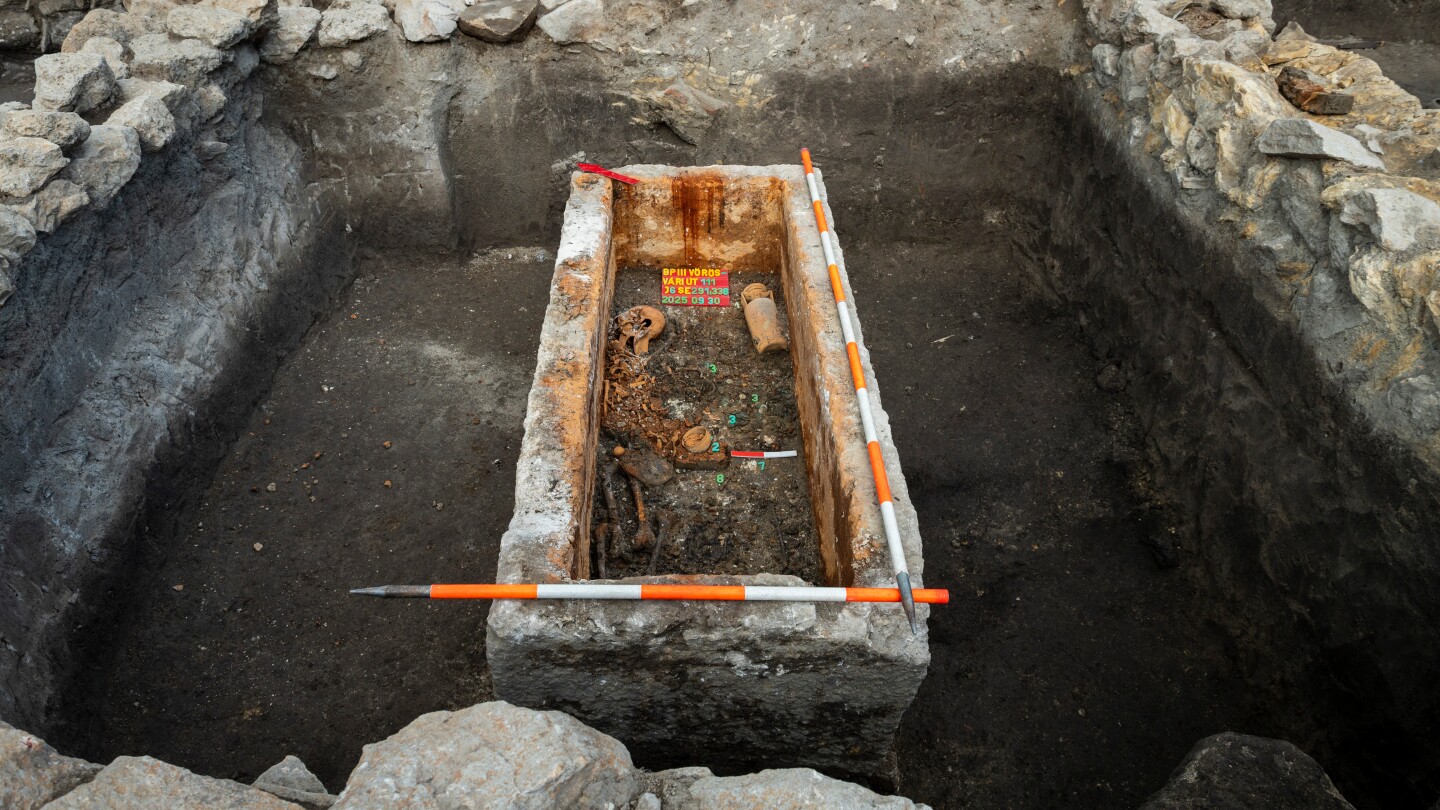
A remarkably well-preserved Roman sarcophagus, dating back approximately 1,700 years, has been discovered in Budapest, Hungary, shedding light on the life of a young woman and the Roman era she lived in. The limestone coffin was unearthed during a large-scale excavation in Óbuda, a northern district of Budapest that was once part of Aquincum, a thriving Roman settlement on the Danube frontier. The sarcophagus, found with its stone lid still intact and sealed with metal clamps and molten lead, contained a complete skeleton surrounded by dozens of artifacts, offering a rare glimpse into ancient Roman burial practices. Gabriella Fényes, the lead archaeologist of the excavation, emphasized the uniqueness of the find, stating that the sarcophagus was hermetically sealed and undisturbed, making it an exceptional discovery. The coffin was located among the ruins of abandoned houses in an area of Aquincum that was repurposed as a burial ground in the 3rd century. Nearby, researchers also uncovered a Roman aqueduct and eight simpler graves, though none matched the richness or pristine condition of the sealed tomb. The sarcophagus contained an array of objects, including two intact glass vessels, bronze figures, 140 coins, a bone hair pin, a piece of amber jewelry, and traces of gold-threaded fabric, all of which suggest the grave belonged to a young woman of high social status. Fényes noted that these items were likely given to the deceased by her relatives for her eternal journey, reflecting the care and love they had for her. The discovery is particularly significant as it provides insights into the Roman province of Pannonia, which encompassed much of modern-day Hungary. Anthropologists will now examine the remains to learn more about the woman’s age, health, and origins. Gergely Kostyál, a Roman-period specialist and coleader of the project, highlighted the rarity of finding an untouched sarcophagus from the 4th century, as it was common practice to reuse earlier sarcophagi. Excavators also removed a layer of mud from inside the coffin, which Fényes hopes may contain additional treasures, such as jewelry. For Fényes, the discovery is not only scientifically valuable but also emotionally resonant, offering a poignant glimpse into the devotion and love of an ancient people.
Archaeologists lift the lid on a 1,700-year-old Roman sarcophagus hidden beneath Budapest