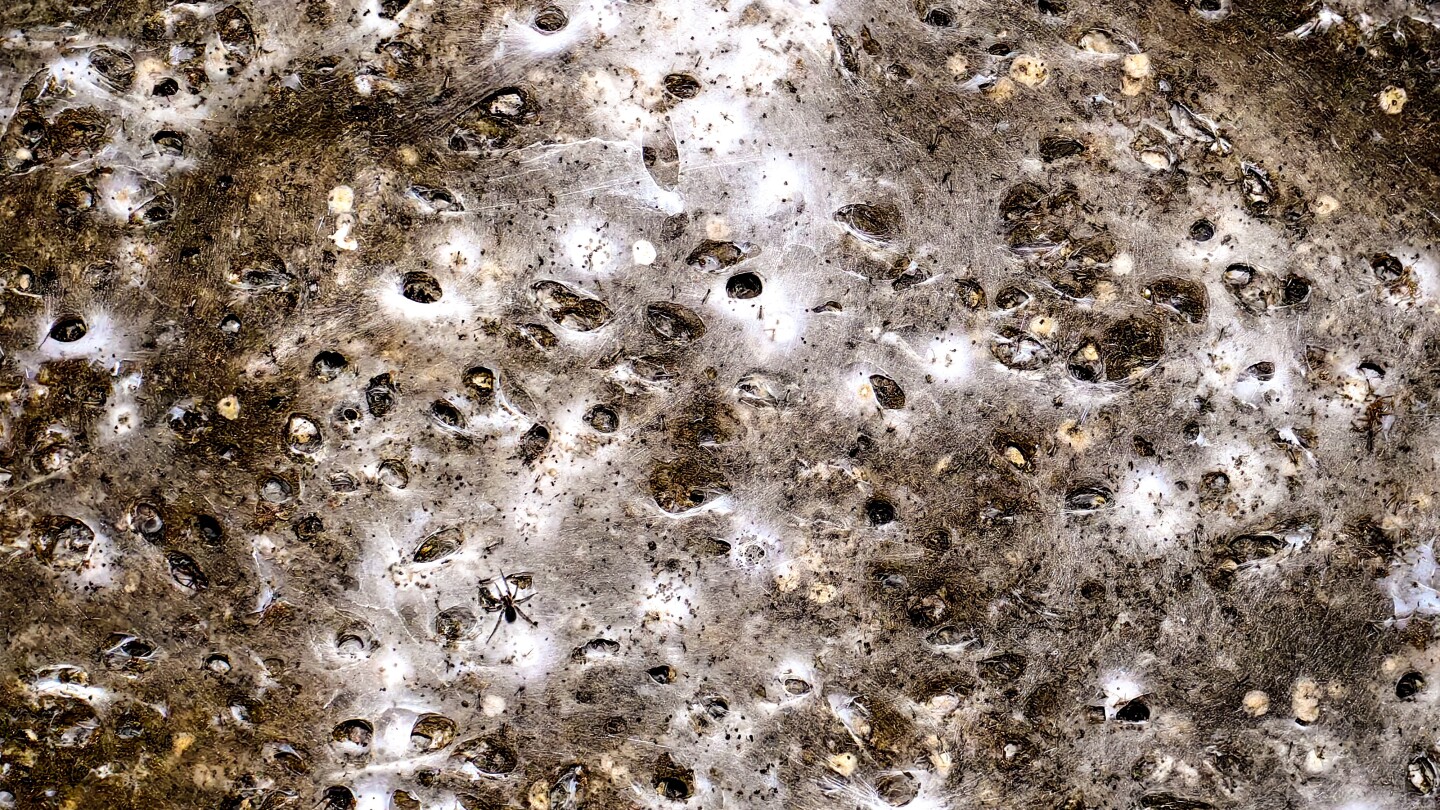
In a groundbreaking discovery, researchers have uncovered what is believed to be the world’s largest spider web, spanning an astonishing 1,140 square feet, within a sulfur-rich cave on the Albanian-Greek border. This colossal web, described as “carpet-thick,” houses an estimated 110,000 spiders from two distinct species—Tegenaria domestica (common house spider) and Prinerigone vagans—living harmoniously in a rare display of interspecies cohabitation. The findings, published in the journal Subterranean Biology, have captivated the scientific community and the public alike due to the unprecedented nature of this discovery. Evolutionary biologist Lena Grinsted, a senior lecturer at the University of Portsmouth, likened the phenomenon to humans sharing an apartment block, emphasizing the rarity of such group living among spiders. The cave’s unique environment, characterized by permanent darkness and an abundance of midge flies, is believed to facilitate this peaceful coexistence. Researchers speculate that the spiders’ reliance on vibratory cues for prey detection, rather than vision, may have contributed to their non-aggressive behavior. The study also revealed that the cave’s ecosystem supports large bat colonies, creating a thriving, interconnected habitat. While the discovery raises intriguing questions about evolutionary biology, it also underscores the importance of preserving such unique environments for future scientific exploration.
Arachnid super-web reveals the surprising ‘constant party’ life of cohabiting spiders