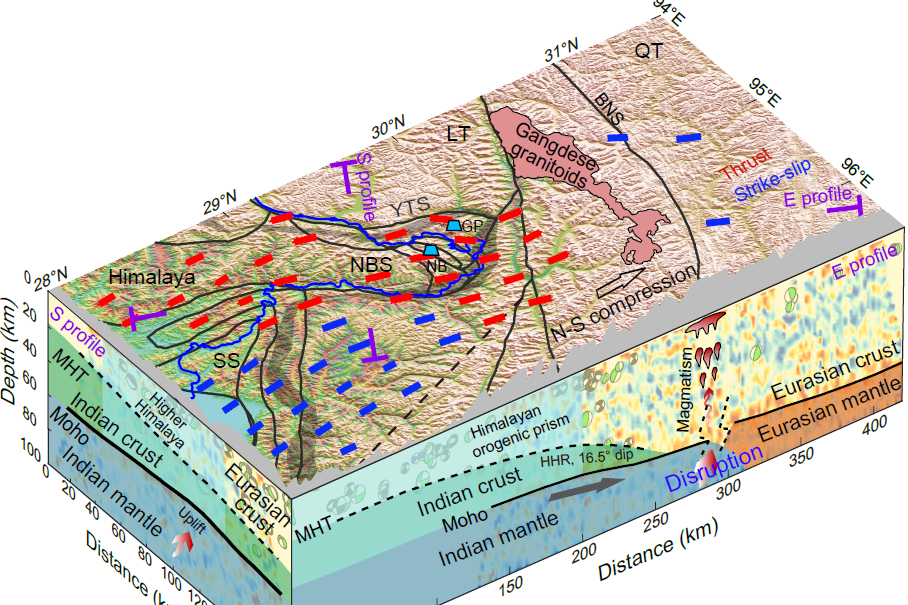
In a groundbreaking study published in the National Science Review, Chinese researchers have decoded the mechanisms driving seismic activities in the eastern Himalayas. This discovery sheds light on the region’s earthquake risks and the geological processes shaping this iconic mountain range. The Himalayas, formed by the collision of the Indian and Eurasian tectonic plates, have long been a focal point for seismic research. While the central section is well understood, the eastern Himalayas’ tectonic complexity has remained a mystery until now. Scientists from the Institute of Tibetan Plateau Research, Chinese Academy of Sciences, employed advanced broadband seismic arrays to analyze the regional stress field and the structural dynamics of the converging plates. Their findings reveal a dominant north-south horizontal compression, coupled with the gentle underthrusting of the Indian plate. This combination explains both the generation of megathrust earthquakes and the uplift of the mountain ranges. Dr. Bai Ling, the study’s lead author, emphasized the next phase of research will explore how continental collision influences seismic activity and plateau evolution. This study not only advances scientific understanding but also enhances earthquake preparedness in the region.