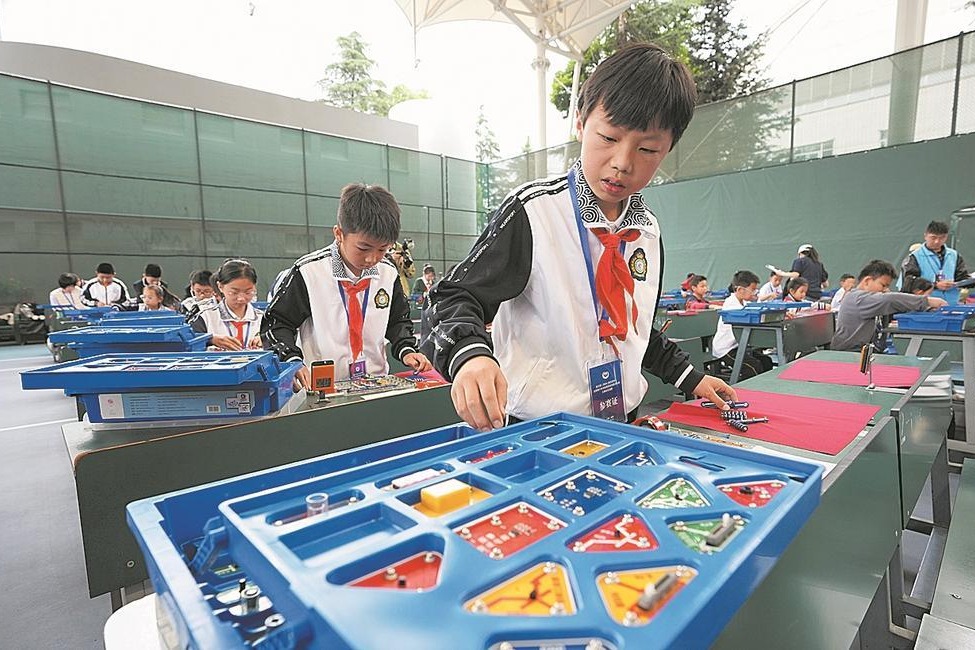
China has introduced a groundbreaking guideline aimed at bolstering science and technology education in primary and secondary schools. The initiative seeks to foster curiosity, creativity, and hands-on learning among students, laying the foundation for a self-reliant nation with a robust talent pool. By 2030, the plan envisions a well-structured system featuring an enhanced curriculum, superior teaching quality, and advanced evaluation methods. The Ministry of Education, along with six other departments, unveiled the guideline during a recent press conference. Tian Zuyin, Director of the Department of Basic Education, emphasized that this move aligns with the principles set forth at the fourth plenary session of the 20th Central Committee of the Communist Party of China, which stressed the importance of a coordinated education and science system. The guideline outlines specific objectives for different educational stages. Lower primary students will engage in playful, life-oriented activities to spark curiosity, while senior primary students will undertake hands-on experiments and project-based tasks. Middle school students will tackle cross-disciplinary projects addressing real-world issues, and high school students will explore cutting-edge scientific advancements and conduct experimental research. The plan also advocates for the integration of scientific and humanistic education, encouraging students to consider the societal, environmental, and ethical implications of technological progress. Assessment methods will be diversified to reduce reliance on examinations, thereby alleviating the burden on teachers and students. The establishment of the UNESCO International Institute for STEM Education in Shanghai underscores international recognition of China’s efforts in this domain. Provinces like Zhejiang, Jiangsu, and Chongqing have already taken proactive steps, incorporating technology into curricula and investing in science labs. With over 1,150 science museums and numerous national science education bases, China is well-positioned to cultivate the next generation of innovators. Xu Xuejun, Vice-President of Tongji University, highlighted the importance of early education in building a strong foundation for long-term scientific and technological advancement.