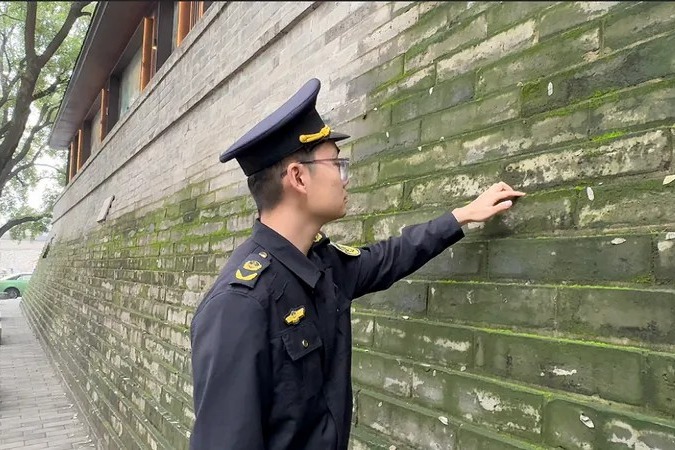
The historic Xi’an City Wall, a UNESCO World Heritage Site, is undergoing a thorough health assessment following months of heavy rainfall linked to climate change. Since September, Shaanxi province has experienced three prolonged rainy periods, with 87 monitoring stations recording over 20 days of rainfall. The average precipitation reached 314 millimeters, 1.6 times higher than the normal level, marking the second-highest rainfall since 1961. This has raised concerns about the structural integrity of the ancient wall, which dates back to the Ming Dynasty (1368-1644).
Gao Heng, head of the cultural heritage protection department of the Xi’an City Wall Management Committee, highlighted the risks posed by water infiltration. Increased moisture has led to surface deterioration, such as moss and lichen growth, and structural issues, including water seeping into the wall’s rammed-earth core. This can reduce the soil’s bearing capacity, potentially causing localized settlement or collapse.
To mitigate these risks, the committee has implemented a differentiated maintenance approach. Routine measures include sealing cracks and re-leveling surface bricks, while engineering solutions involve re-compacting loose soil and enhancing drainage systems. A key drainage project, approved by the National Cultural Heritage Administration, is underway to divert rainwater from the wall’s foundation.
Technology plays a crucial role in preservation efforts. Since 2018, a ‘digital cabin’ system with over 3,000 sensors has monitored settlement and crack displacement. Drones conduct aerial inspections quarterly, and a four-color warning system assesses risks based on damage severity. In 2023, a comprehensive ‘CT health scan’ using ground-penetrating radar revealed over 1,300 historical cavities and 800 areas of less compact soil within the wall.
Collaboration with local meteorological bureaus and academic institutions ensures specialized weather forecasts and technical support. The committee has also introduced a ‘wall chief’ system, assigning individuals to oversee specific sections for routine monitoring and early issue reporting.
Despite these challenges, Gao emphasized that the wall’s original structure remains intact, with only restored outer layers affected by recent damage. The ongoing efforts aim to safeguard this cultural treasure for future generations.