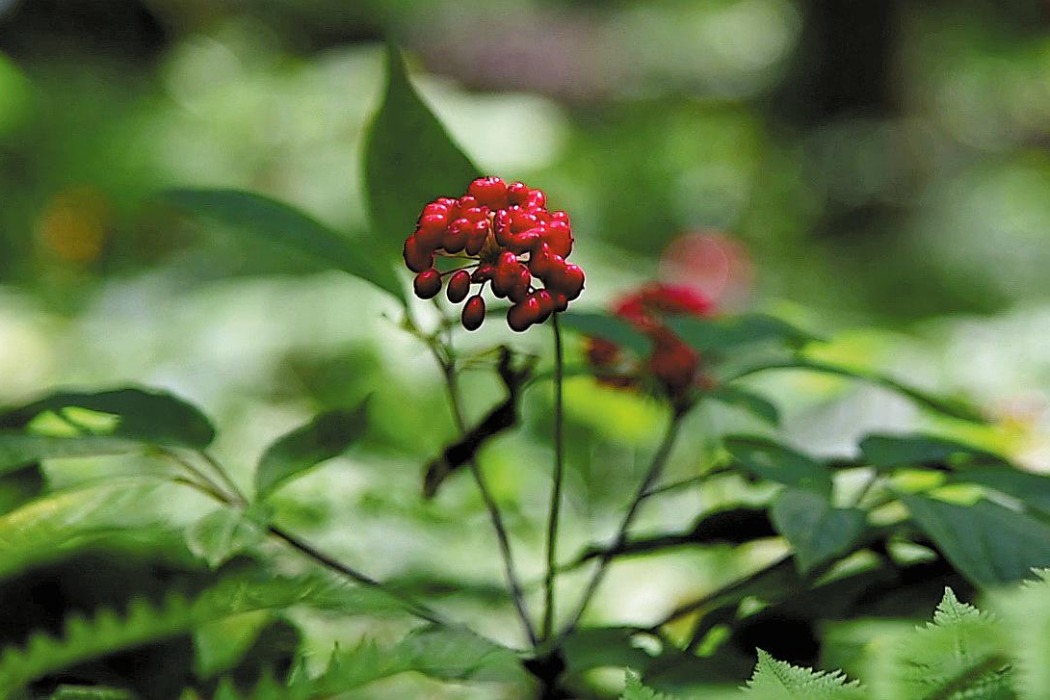
Under the golden autumn sun of Changbai Mountain, 70-year-old Cui Chang’an, a fourth-generation ginseng master, carefully uncovers a ginseng root that has grown for over three decades. ‘We never just dig ginseng,’ Cui explains. ‘We lift it, leave the small ones, and replant the seeds. That’s how the mountain keeps giving.’ This ancient practice is the cornerstone of Fusong county, known as China’s hometown of ginseng, where the tradition of gathering ginseng, called Fangshan, has been recognized as a national intangible cultural heritage since 2008. Fusong boasts over 460 years of documented cultivation history, with wild collection in the Changbai Mountain region dating back more than 1,500 years. Today, about 45,000 people in Fusong are employed in the ginseng industry, managing 14,000 hectares of wild-simulated ginseng, producing nine metric tons valued at 135 million yuan ($18.9 million). Ginseng is cultivated in two main ways: garden ginseng, grown on flat land like ordinary crops, and wild-simulated ginseng, which grows naturally under forest canopy and is considered equivalent to wild ginseng, a national first-class protected plant. At the heart of Fusong lies Wanliang, home to the world’s largest national-level ginseng market, where 80 percent of China’s ginseng is traded. Products from this small town are exported globally, particularly to Japan, South Korea, and Southeast Asian countries, with items like ginsenosides soaps exceeding 100,000 pieces annually. Fusong now produces five major categories of ginseng goods — food, health supplements, cosmetics, medicines, and bioproducts — totaling more than 600 varieties. Fusong County Natural Biotechnology Co, a provincial high-tech leader, is at the forefront of innovation, being the only firm in China capable of extracting individual ginsenosides like RH2 and RG3. With rising global wellness awareness, demand for ginseng continues to grow. Experts like Wang Defu, honorary president of the Fusong Ginseng Culture Research Association, see a promising future for Chinese ginseng, emphasizing the need for a stronger international brand and greater global recognition. Supported by government initiatives focusing on standardization, brand development, market expansion, and technology integration, the ginseng industry in Fusong is thriving, ensuring its position as a global ginseng hub. For Cui Chang’an, the legacy of ginseng is timeless. ‘I may never find the ginseng my grandfather planted,’ he reflects. ‘But someone will, and the mountains will keep giving.’