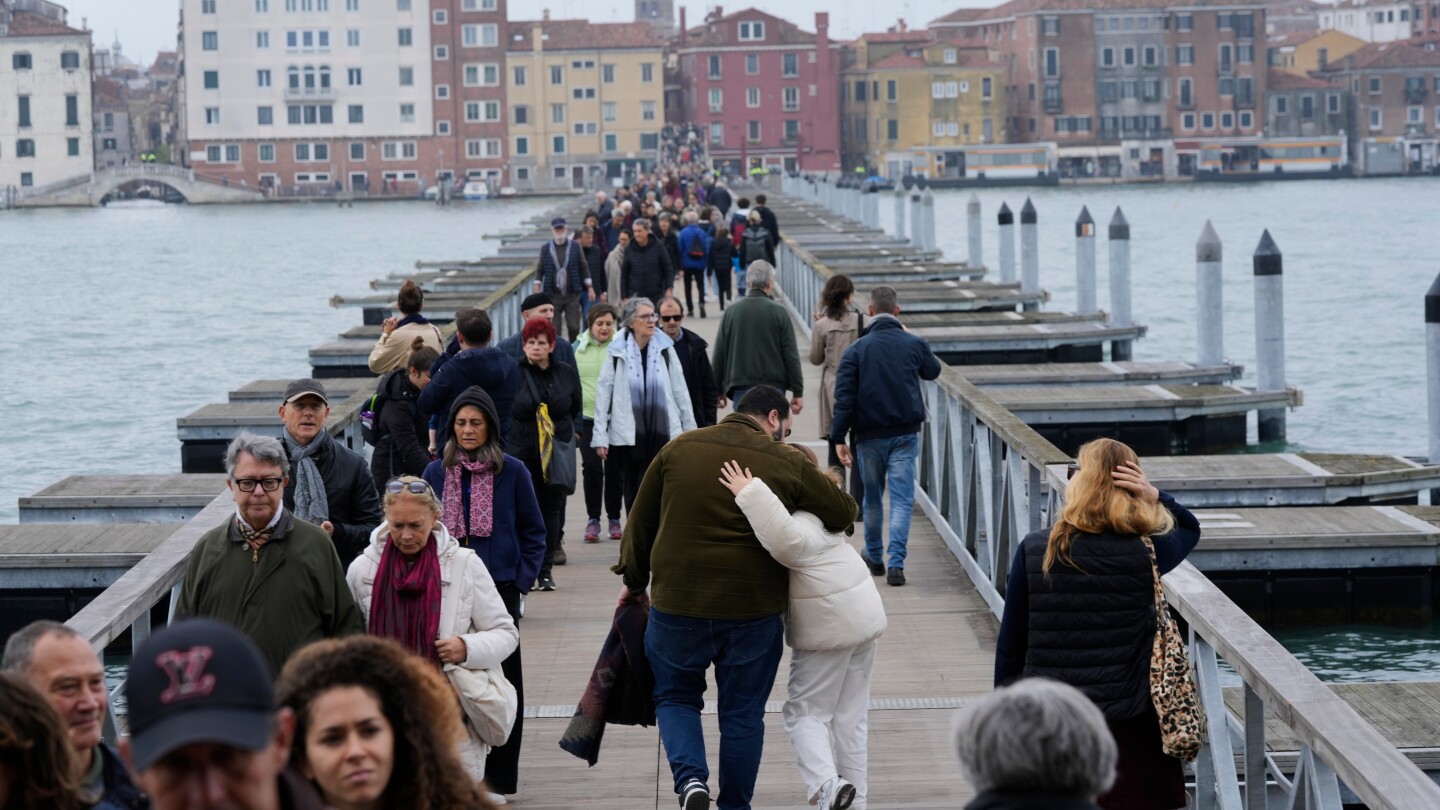
Venice, Italy – In a poignant revival of a long-dormant tradition, the city of Venice has once again constructed a temporary floating bridge to connect the mainland to San Michele Island, the historic cemetery where luminaries like American poet Ezra Pound and Russian composer Igor Stravinsky rest. This year, the 407-meter (quarter-mile) bridge, known as the ‘Votif’ Bridge, allowed Venetians to walk across the lagoon to pay their respects to the deceased on All Souls’ Day, a Catholic holiday dedicated to honoring the dead.
The tradition, which dates back centuries, originally involved using Venetian ‘peata’ boats lashed together with walking planks. However, the practice was discontinued in the 1950s as public water buses made the island more accessible. After a seven-decade hiatus, the bridge was reintroduced in 2019 using a modern modular pontoon design. Although the COVID-19 pandemic disrupted plans to make it an annual event, the city successfully revived the tradition this year.
Venice Mayor Luigi Brugnaro emphasized the significance of the bridge, calling it a ‘concrete journey’ that reconnects history with the living. ‘It’s not fake, not philosophical. By foot, over the water, it’s a beautiful route that makes you understand a lot about Venice,’ he said. The bridge, which arches to allow boat traffic, is the longest of Venice’s temporary bridges, surpassing those built for the Feast of the Redentore and the Feast of the Madonna della Salute.
The bridge opened on Thursday, November 1, in anticipation of All Souls’ Day on November 2. Initially reserved for residents, it will open to tourists on Monday. Antonio Vespignani, a local resident, shared his thoughts: ‘I usually don’t go to the cemetery for various reasons, but I’m taking advantage of this very rare circumstance. It’s a way for me to visit my loved ones.’
San Michele Island, established as a cemetery in 1807 under Napoleon’s decree, remains Venice’s principal burial ground despite the city’s population shift to the mainland. The island’s 15th-century church lends its name to the cemetery, which was expanded by filling in a neighboring canal. For visitors like Zhang Miao, a Chinese tourist, the bridge offered a convenient and free return to the mainland after an unexpected visit to the cemetery.
This revival of the floating bridge tradition not only honors the dead but also underscores Venice’s enduring connection to its history and cultural heritage.