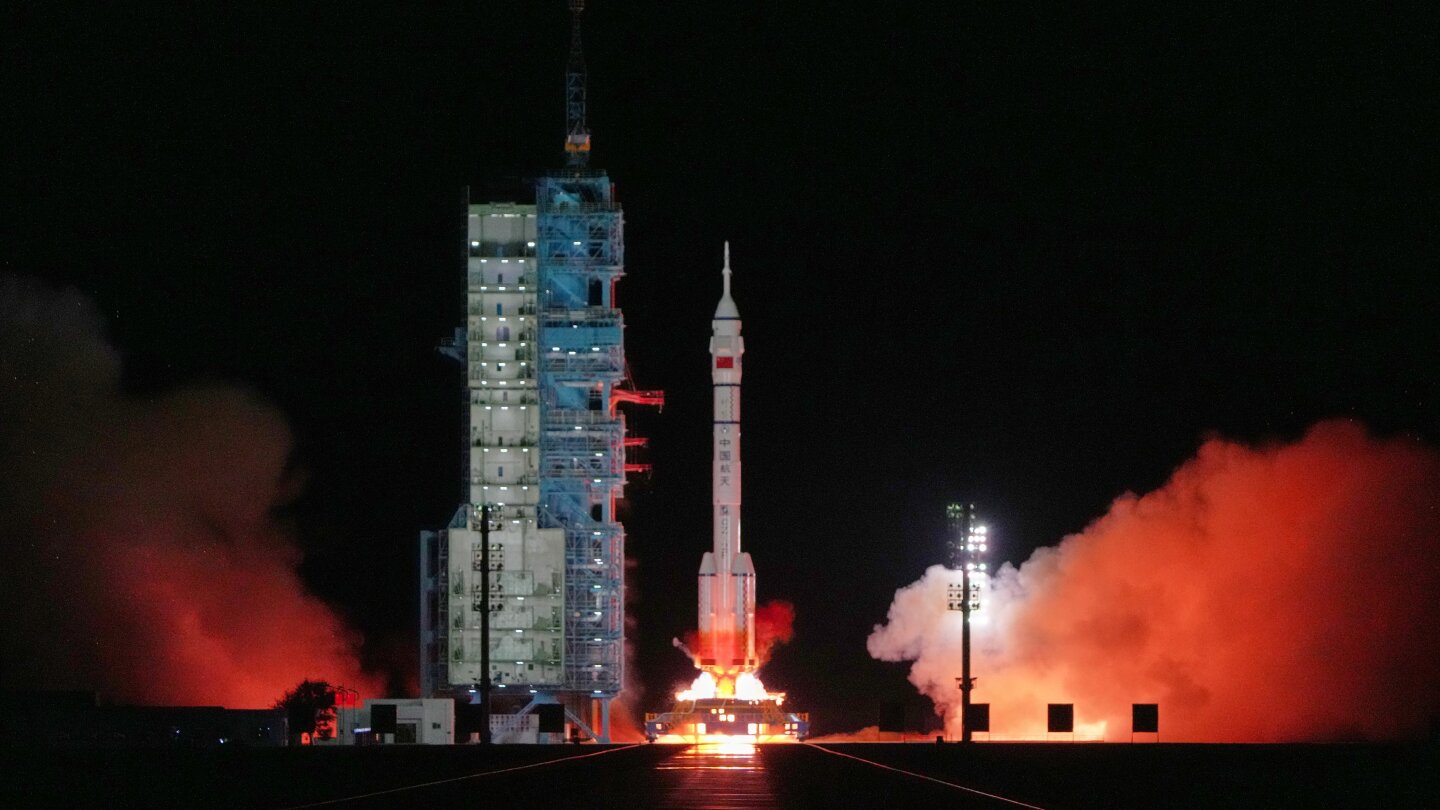
China has successfully launched the Shenzhou-21 spacecraft, marking another milestone in its ambitious space program. The mission, which took off at 11:44 p.m. local time on Friday from the Jiuquan launch center in northwestern China, is sending three astronauts and four mice to the Tiangong space station. The crew includes mission commander Zhang Lu, a veteran of the Shenzhou-15 mission, alongside first-time astronauts Wu Fei, a 32-year-old engineer, and Zhang Hongzhang, a payload specialist with a background in new energy and materials research. The astronauts are expected to stay aboard the station for approximately six months, conducting 27 scientific experiments in fields such as biotechnology, aerospace medicine, and materials science. Notably, this mission includes the first-ever mice sent to China’s space station, with the aim of studying the effects of weightlessness and confinement on their behavior. The mice, selected from 300 candidates after rigorous training, will remain in space for five to seven days before returning to Earth. China’s space program, a source of national pride, continues to advance, with plans to land astronauts on the moon by 2030. The Tiangong space station, entirely Chinese-built, underscores China’s growing role in space exploration, particularly after being excluded from the International Space Station due to U.S. security concerns. Additionally, China is collaborating with Pakistan to train two Pakistani astronauts, one of whom may visit the Tiangong station in the future.