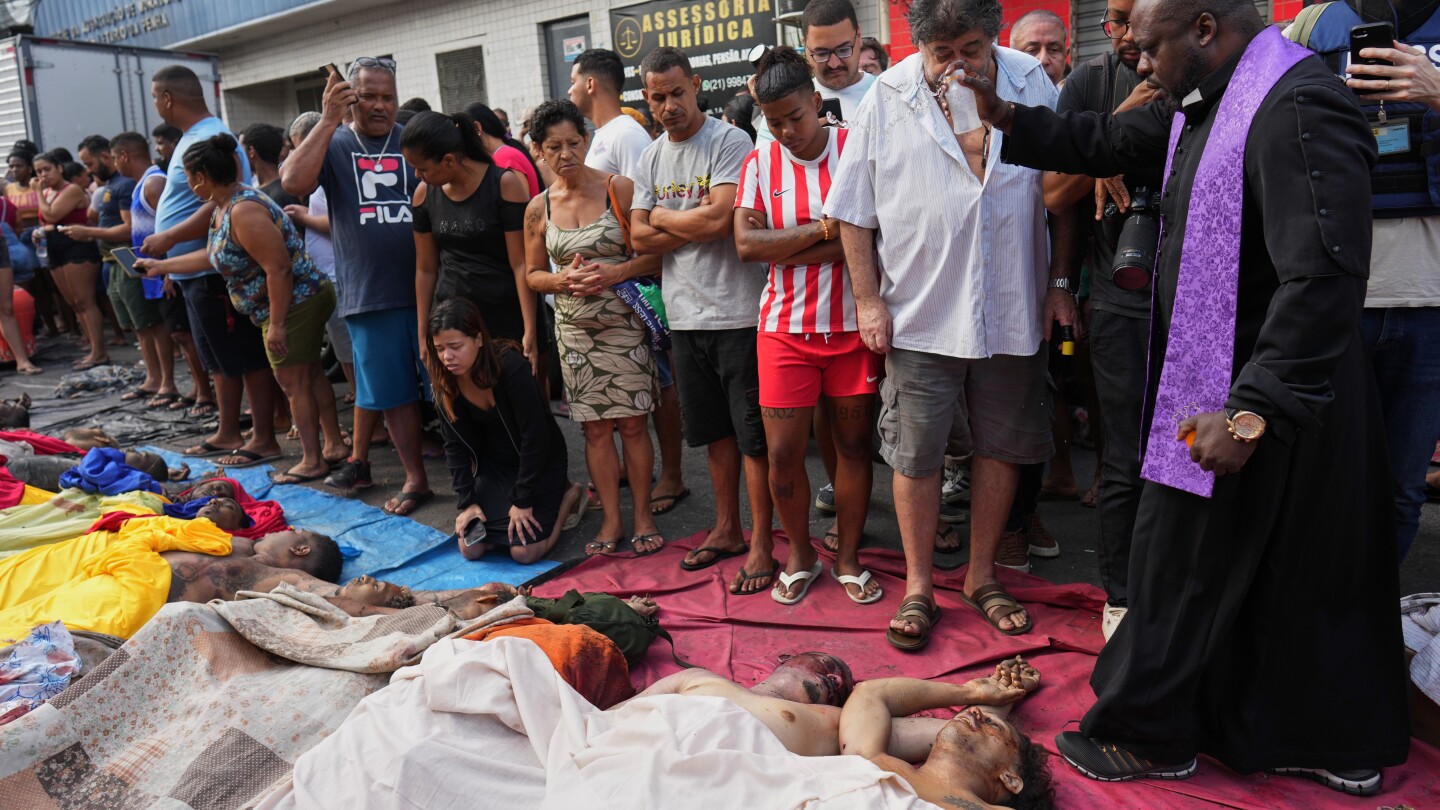
In the wake of a massive police operation targeting a notorious drug gang, residents of a Rio de Janeiro favela spent the night collecting bodies from their community and laying them in a central square. By early Wednesday morning, at least 50 bodies, mostly of young men, were displayed in Penha, one of the two sites targeted in what has become Rio’s deadliest police raid. Critics have condemned the operation as another example of Brazil’s excessive use of force. The raid, involving 2,500 police and soldiers, resulted in at least 64 deaths, including 60 suspected gang members and four officers, according to state Governor Claudio Castro and police officials. Residents, however, believe the death toll is higher, with some bodies yet to be counted. Many victims were found in a wooded area near the community. Forensic authorities retrieved the bodies by late Wednesday morning, but the state government has not yet commented on the incident. Local activist Raull Santiago, part of a team that discovered about 15 bodies before dawn, described the scene as a massacre, with victims showing signs of execution, including gunshots to the head and stab wounds. Governor Castro defended the operation, stating that Rio is at war against ‘narco-terrorism,’ a term reminiscent of the Trump administration’s campaign against drug smuggling in Latin America. The state government claimed those killed had resisted police action. Rio has a long history of lethal police raids, but the scale and lethality of Tuesday’s operation are unprecedented. Non-governmental organizations and the U.N. human rights body have raised concerns and called for investigations. The operation aimed to capture leaders and curb the territorial expansion of the Red Command criminal gang, which has tightened its grip on favelas in recent years. Police arrested 81 suspects and seized 93 rifles and over half a ton of drugs. The raid triggered violent retaliation from gang members, leading to chaos across the city. Schools and a local university canceled classes, and roads were blocked with buses used as barricades. Gang members reportedly targeted police with drones, one of which was captured on video firing a projectile. Governor Castro criticized the federal government for not providing sufficient support, a claim challenged by the Justice Ministry, which stated it had responded to Rio’s requests for national forces. Gleisi Hoffmann, the Lula administration’s liaison with parliament, acknowledged the need for coordinated action but highlighted recent anti-money laundering efforts as evidence of federal action against organized crime. Lula’s chief of staff, Rui Costa, called for an emergency meeting in Rio with local authorities and the Justice Minister. Criminal gangs have expanded their presence across Brazil, including in the Amazon rainforest. Filipe dos Anjos, secretary general of favela rights’ organization FAFERJ, argued that such police operations fail to address the root problem, as organized crime quickly reorganizes. ‘In about thirty days, they will be back to selling drugs, stealing cargo, and collecting payments,’ he said, adding that these operations achieve little for society.
Brazilians in a Rio favela line up bodies after the city’s deadliest police raid