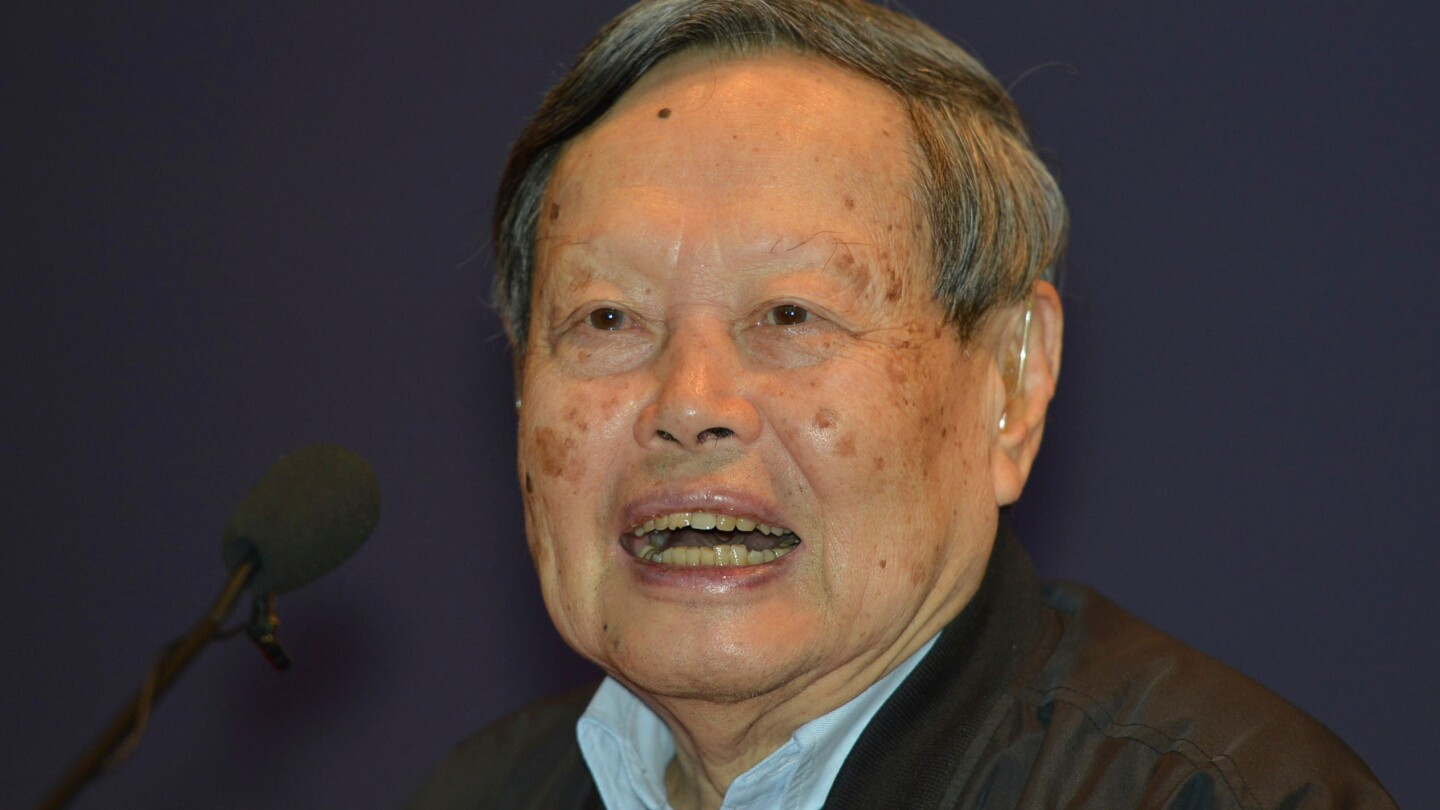
Renowned physicist Chen Ning Yang, a Nobel Prize laureate and one of the most influential figures in modern physics, passed away in Beijing on Saturday at the age of 103. Tsinghua University, where Yang both studied and taught, confirmed his death in a statement, attributing it to an unspecified illness. The university hailed Yang as one of the greatest physicists of the 20th century, emphasizing his groundbreaking contributions to the field of physics and his significant role in advancing China’s scientific and educational landscape. Yang, along with Tsung-Dao Lee, was awarded the Nobel Prize in Physics in 1957 for their groundbreaking work on parity laws, which led to pivotal discoveries in elementary particle physics. This achievement marked them as the first Chinese-born physicists to receive the prestigious award. In his Nobel Banquet speech, Yang reflected on his dual heritage, expressing pride in his Chinese roots while acknowledging his deep connection to Western scientific traditions. He famously stated, ‘I am heavy with an awareness of the fact that I am in more than one sense a product of both the Chinese and Western cultures, in harmony and in conflict.’ Yang’s legacy also includes the development of the Yang–Mills theory, a cornerstone of modern physics, which he co-authored with American physicist Robert Mills. Born in 1922 on the Tsinghua University campus, where his father was a mathematics professor, Yang pursued his undergraduate and master’s degrees at Tsinghua before earning his doctorate at the University of Chicago in 1946. He was profoundly influenced by Italian-American physicist Enrico Fermi, a fellow Nobel laureate. Yang’s academic career spanned prestigious institutions, including the Institute for Advanced Study in Princeton and the Chinese University of Hong Kong, where he served as a distinguished Professor-at-large and made generous donations, including his Nobel Prize. In 2015, Yang renounced his U.S. citizenship, a decision he described as difficult but necessary, reflecting on the opportunities the country had provided him. He is survived by three children.