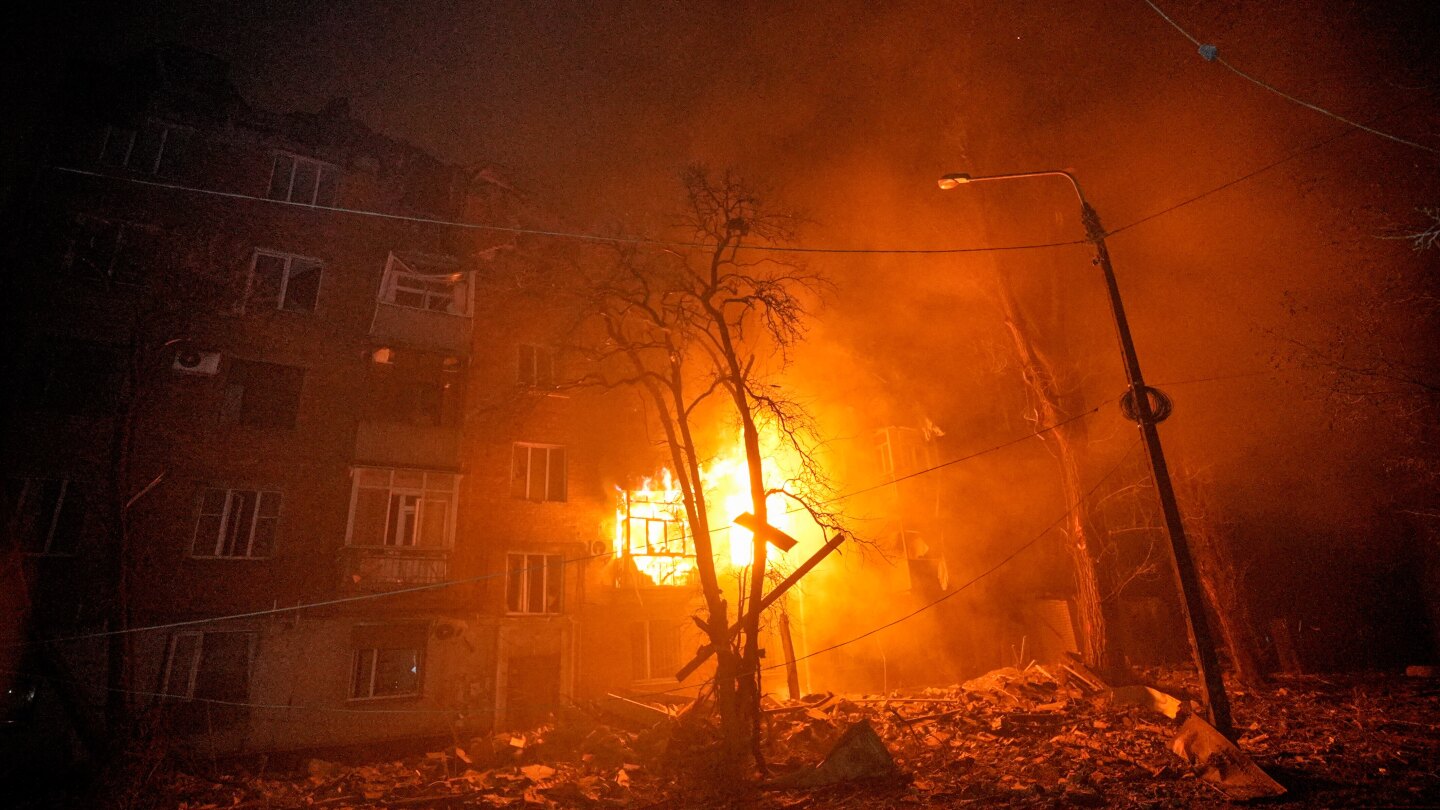
Kyiv faced a harrowing 12-hour bombardment on Sunday, resulting in multiple fatalities and over 70 injuries across Ukraine. The attack, involving hundreds of drones and nearly 50 missiles, targeted civilian infrastructure, including a cardiology center in the capital. This escalation comes as the US deliberates Ukraine’s request for long-range Tomahawk missiles, which could potentially strike deep into Russian territory. US Vice-President JD Vance indicated that President Donald Trump would have the final say on the matter, while US Special Envoy Keith Kellogg hinted that Trump had already authorized such strikes. Kremlin spokesman Dmitry Peskov dismissed the potential impact of these weapons, asserting that no missile could alter the dynamics of the conflict. Ukraine’s Deputy Defence Minister Ivan Havryliuk emphasized that increasing the cost of war for Russia could compel Moscow to engage in peace talks. Meanwhile, Ukraine is seeking advanced air defense systems, including Patriot units, to counter Russia’s intensified aerial assaults. The country is also ramping up its domestic production of drones and artillery, aiming to reduce reliance on Western allies. However, the urgency for immediate support remains critical as Russia continues to deploy more sophisticated drones and missiles, posing a growing threat to Ukraine’s cities and Europe’s security.
标签: Europe
欧洲
-

Stars turn out for final Armani fashion show in Milan
The Giorgio Armani spring/summer 2026 collection show in Milan on Sunday transformed into a heartfelt tribute to the late Italian designer, who passed away earlier this month at the age of 91. Originally planned to celebrate 50 years of his iconic fashion house, the event became a poignant homage to Armani’s enduring legacy. Held at the Pinacoteca di Brera art gallery, the show featured over 120 of his creations, with models from the past five decades returning to showcase a blend of classic suits and dazzling dresses. The collection drew inspiration from Milan, Armani’s home city, and Pantelleria, the volcanic island where he maintained a holiday retreat. Paper lanterns adorned the courtyard, reminiscent of the public viewing of Armani’s body earlier in the month, as models walked under the portico. The color palette of neutrals, greens, blues, and purples evoked the natural beauty of light, earth, and sea. The final piece, a long-sleeved blue gown worn by Agnese Zogla, one of Armani’s favorite models, featured a subtle image of his face, earning a standing ovation from the 700 guests. The event also included a visit to the ‘Giorgio Armani: Milano, Per Amore’ exhibition, showcasing iconic outfits alongside Italian art masterpieces. Celebrities such as Cate Blanchett, Glenn Close, Richard Gere, Samuel L. Jackson, and Spike Lee attended, with Blanchett describing Armani as a ‘deeply human, talented individual.’ Italian composer Ludovico Einaudi provided live piano music, while outgoing Vogue editor-in-chief Anna Wintour graced the event, marking the conclusion of Milan Fashion Week. Across town, Meryl Streep and Stanley Tucci, filming ‘The Devil Wears Prada’ sequel, were seen at the Dolce & Gabbana show, adding to the city’s vibrant fashion scene.
-

Three reported dead at ‘serious incident’ in County Louth
A devastating incident has unfolded in County Louth, Republic of Ireland, where three members of the same family have tragically lost their lives. Gardaí, the Irish police force, were called to the scene in Tallanstown on Monday morning following reports of a violent attack. The victims, identified as two men and a woman, sustained fatal injuries in what is being described as a ‘serious’ incident. Authorities have confirmed that the investigation is still in its preliminary stages, with no further details disclosed at this time. The community has been left in shock as they await more information from law enforcement. This heartbreaking event underscores the need for continued vigilance and support for families in crisis.
-

Dublin deaths ‘being treated as murder-suicide’
A devastating incident has rocked the quiet neighborhood of Finglas in Dublin, as the bodies of a man and a five-year-old girl were discovered in a local residence on Saturday evening. The grim discovery was made shortly before 20:00 local time, with authorities treating the case as a suspected murder-suicide. Initial reports suggest the victims were father and daughter. The child’s mother, who returned home from work, is believed to have found the tragic scene. Post-mortem examinations are scheduled to determine the exact circumstances surrounding their deaths. As of Monday, the house remains cordoned off, with forensic teams conducting a thorough investigation. The community has been left in shock, grappling with the heartbreaking loss of a young life and the circumstances that led to this tragedy.
-

Denmark bans all civilian drone flights ahead of European summit
Denmark has implemented a comprehensive ban on all civilian drone flights this week in anticipation of the European Union summit in Copenhagen. The country’s transport minister announced the decision on Sunday, citing the need to ‘simplify security operations’ for law enforcement and prevent ‘foreign drones from causing uncertainty and disruption.’ The ban, effective until October 3, carries severe penalties, including fines or imprisonment for up to two years. This move follows a series of recent drone sightings over Danish military sites and airports, which have raised significant security concerns. In response, defense ministers from ten EU countries have agreed to establish a ‘drone wall,’ while NATO has heightened its vigilance across the Baltic region. Danish authorities have yet to identify the perpetrators behind these incursions, with the defense minister labeling them as part of a ‘hybrid attack’ and a ‘systematic operation.’ Prime Minister Mette Frederiksen has not ruled out Russian involvement, though Moscow has vehemently denied any connection. The situation has also prompted Norway and Romania to report similar drone incidents, with Romania recently passing legislation to empower air force pilots to shoot down unidentified aircraft. The ongoing war in Ukraine and previous Russian incursions into NATO airspace have further intensified regional tensions.
-

The picturesque Dutch village set to charge tourists an entry fee
The iconic Dutch village of Zaanse Schans, renowned for its historic windmills, is grappling with an overwhelming influx of tourists. This year, the village is projected to attract 2.8 million visitors, a significant increase from the 2.6 million recorded last year. For a community with a resident population of just 100, this surge has become unsustainable. In response, the local council has announced a new €17.50 ($20.50; £15) entry fee for non-residents, effective next spring, aimed at curbing the numbers and preserving the village’s charm. This measure is rare but deemed necessary by local authorities, including Marieke Verweij, director of the village’s museum, who highlights the strain on the community. ‘Visitors often intrude into private gardens and homes, leaving residents with no privacy,’ she explains. The fee will grant access to the museum and windmills, which currently require separate payments. The museum houses a painting by Claude Monet, while the windmills showcase their 17th-century industrial uses. However, local businesses fear the fee will deter budget-conscious tourists, threatening their livelihoods. Sterre Schaap, co-owner of a gift shop, warns, ‘Families may spend €100 on entry and parking, leaving little for shopping.’ Despite concerns, some tourists, like Elisia from Albania, support the fee, believing it will protect the village’s charm. The council plans to reinvest the revenue in infrastructure and windmill maintenance, addressing the village’s growing needs.
-

Moldovans await pivotal election result as leader warns of Russian interference
Moldova’s parliamentary elections, held amidst allegations of significant Russian interference, have been described as a pivotal moment for the nation’s democratic future and its aspirations to join the European Union. President Maia Sandu, a staunch advocate for European integration, emphasized the fragility of Moldova’s democracy and the threats posed by external influences, particularly from Russia. Speaking outside a polling station in Chisinau, Sandu urged citizens to safeguard their votes, warning that the nation’s future hangs in the balance.
-

Swiss voters narrowly approve plan for electronic ID cards
In a closely contested referendum, Swiss voters have narrowly endorsed the introduction of voluntary electronic identity cards, with 50.4% voting in favor and 49.6% opposing the measure. This outcome defied earlier opinion polls, which had predicted a 60% approval rate for the digital IDs, a proposal supported by the Swiss government and both houses of parliament. The vote marks Switzerland’s second attempt at implementing digital IDs, following the rejection of a 2021 proposal due to concerns over centralized data control by private entities. The revised plan ensures that the system remains under government oversight, with data stored exclusively on users’ smartphones and the use of digital IDs remaining optional. Citizens retain the choice to continue using traditional national identity cards, a long-standing standard in Switzerland. To address privacy concerns, authorities will only be able to access specific details, such as proof of age or nationality, when necessary. This development coincides with the UK government’s announcement of its own mandatory digital ID system aimed at curbing illegal migration, which has sparked similar privacy and security debates. Proponents of the Swiss system argue that it will streamline bureaucratic processes, from obtaining phone contracts to age verification for purchases. However, opponents, who successfully petitioned for the referendum, remain wary of potential privacy infringements and misuse of data for tracking or marketing purposes. Switzerland’s strong tradition of privacy protection, exemplified by its banking secrecy laws and stringent regulations on services like Google Street View, underscores the cautious approach to digital innovation.
-

Fisherman ‘lost his life doing what he loved’
The Irish fishing community is mourning the loss of Kevin McCloskey, a seasoned fisherman and former chairman of the Killybegs Fishermen’s Organisation (KFO), who tragically lost his life after his boat ran aground off the Sligo coast. McCloskey, a resident of County Donegal, had been missing since Thursday evening when a member of the public alerted authorities after spotting his stranded vessel with its engine still running near Cliffoney Beach. An extensive three-day search operation, led by the Irish Coast Guard and involving multiple agencies, culminated in the discovery of his body off the port village of Teelin on Saturday evening. The KFO expressed deep sorrow over the incident, describing McCloskey as a respected and experienced fisherman who dedicated his life to the industry. The Coast Guard extended its condolences to his family and acknowledged the efforts of all search units and local fishing vessels involved in the operation. McCloskey’s death has been deemed a significant loss for the fishing community, with the KFO noting that he was known for his positive outlook on life and his passion for fishing.
-

Poland says jets scrambled over Russian attack on Ukraine
Poland and NATO swiftly deployed fighter jets early Sunday in response to Russian airstrikes targeting western Ukraine, according to the Polish armed forces. The entire region of Ukraine was placed under air raid alerts, prompting the temporary closure of airspace near Poland’s southeastern cities of Lublin and Rzeszow until at least 0400 GMT. Flight tracking site Flightradar24 cited ‘unplanned military activity related to ensuring state security’ as the reason for the closure. Kyiv Mayor Vitali Klitschko reported a ‘massive attack’ on the capital, with a five-story building partially destroyed by drone debris, leaving at least three people hospitalized. Tensions have intensified following repeated Russian incursions into NATO airspace this month. The Polish military stated on X that its actions, alongside allied forces, were preventive measures to secure airspace and protect citizens. Moscow has denied involvement in recent drone incidents over Denmark, which described the activity as the work of a ‘professional actor’ but found no evidence of Russian responsibility. Estonia also accused Russia of violating its airspace with warplanes. Meanwhile, NATO conducted an air defense mission over Poland in response to Russian drone incursions, including the downing of three Russian drones in Polish airspace on September 10. U.S. President Donald Trump has urged NATO nations to shoot down Russian planes in their airspace, while NATO has vowed to use ‘all necessary tools’ to defend itself. In a speech at the UN General Assembly, Russian Foreign Minister Sergei Lavrov denied intentions to attack EU or NATO states but warned of a ‘decisive response’ to any aggression.