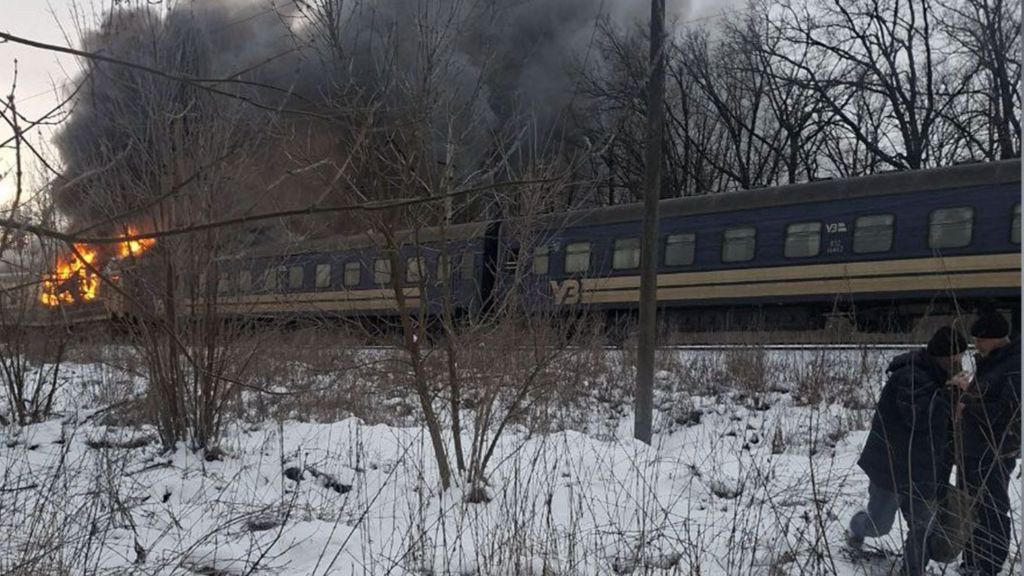
In a devastating escalation of the ongoing conflict, Russia launched a massive drone and missile attack across Ukraine, resulting in the deaths of at least six individuals, including a mother and her two young daughters. The assault, which spanned the night and extended into Wednesday morning, targeted multiple Ukrainian cities, including a village in the Kyiv region where a strike ignited a house, tragically claiming the lives of the family. Regional head Mykola Kalashnyk confirmed the incident, while authorities reported at least 18 injuries in Kyiv alone. The attack also severely damaged Ukraine’s energy infrastructure, causing widespread blackouts as Russia intensifies efforts to disrupt the country’s power grid ahead of the harsh winter season. Amid these developments, U.S.-led initiatives to broker peace have faltered, with President Donald Trump expressing frustration over Russian President Vladimir Putin’s unwillingness to compromise. Ukrainian President Volodymyr Zelenskyy has called for increased military support and international pressure on Russia, emphasizing the need for sanctions, advanced missile capabilities, and coordinated diplomacy. Zelenskyy is set to engage in a week of intense diplomatic efforts, including meetings with Swedish Prime Minister Ulf Kristersson and participation in international summits aimed at bolstering support for Ukraine. Meanwhile, Ukraine’s military reported striking a critical Russian chemical plant in the Bryansk region using British-made Storm Shadow missiles, further escalating the conflict. The international community continues to monitor the situation closely as the war shows no signs of abating.
标签: Europe
欧洲
-

Top UN court to rule on Israel’s obligations to ensure humanitarian aid reaches Palestinians
The International Court of Justice (ICJ) in The Hague is poised to deliver a crucial advisory opinion on Wednesday regarding Israel’s legal responsibilities to ensure the delivery of urgently needed humanitarian aid to Palestinians in Gaza and the occupied West Bank. This ruling comes in response to a request from the U.N. General Assembly, made last year, following Israel’s decision to effectively ban the U.N. agency for Palestinian refugees (UNRWA) from operating in Gaza. UNRWA has been the primary provider of aid in the region. While advisory opinions are nonbinding, they carry significant legal weight and could have far-reaching implications for the U.N. and its global missions. The proceedings, which began in April, predate the fragile U.S.-brokered ceasefire that took effect on October 10, aimed at ending the two-year conflict in Gaza. Despite the ceasefire, tensions flared earlier this week after Israeli forces launched deadly strikes, citing the killing of two soldiers by Hamas militants. Under the ceasefire agreement, Israel is required to allow 600 humanitarian aid trucks into Gaza daily. The U.N. has announced plans to increase aid shipments, and Hamas has acknowledged Israel’s compliance with the agreement. However, Palestinian Ambassador Ammar Hijazi accused Israel of “starving, killing, and displacing Palestinians” while obstructing humanitarian efforts. Israel has denied these allegations, calling the proceedings biased, and did not attend the hearings, though it submitted a 38-page written response. The ICJ’s opinion could reinforce the principle that states cannot selectively restrict U.N. operations, according to international law experts. This case follows previous ICJ rulings critical of Israeli policies, including the West Bank separation barrier and the occupation of Palestinian territories. The advisory opinion is separate from South Africa’s ongoing case accusing Israel of genocide in Gaza, which Israel vehemently denies. The conflict, triggered by Hamas’ October 7 attack on southern Israel, has resulted in significant casualties, with Gaza’s Health Ministry reporting over 68,000 deaths, a figure disputed by Israel.
-

Western Balkans leaders meet in London for talks on migration and security
Leaders from six Western Balkan nations—Albania, Bosnia, Kosovo, Montenegro, North Macedonia, and Serbia—are set to meet with British and European officials in London on Wednesday. The summit, part of the Berlin Process initiated in 2014, aims to address critical issues such as migration, security, and economic growth in a region marked by volatility and Russian influence. Despite Croatia being the only Western Balkan nation to join the EU in 2013, progress for others has stalled, with Serbia and Kosovo particularly at odds over the latter’s independence. The EU’s renewed openness to expansion following Russia’s 2022 invasion of Ukraine has heightened concerns that the conflict could spill over into the Balkans, a region still recovering from its own historical conflicts. The UK, despite its 2020 exit from the EU, is hosting the summit, emphasizing its commitment to curbing unauthorized migration and bolstering regional defenses against Moscow’s interference. British Prime Minister Keir Starmer’s government is prioritizing efforts to tackle the drug trade and reduce migration flows, with gangs smuggling hundreds of thousands of people to the EU via the Western Balkans. The UK has already seen success in reducing Albanian migration through a joint task force and is now seeking to establish ‘return hubs’ for rejected asylum-seekers, though Albania and Montenegro have expressed reluctance to host such facilities. Montenegro’s Prime Minister Milojko Spajic suggested his country might consider a hub if the UK invests €10 billion in railway infrastructure.
-

Ukraine hits Russian chemical plant with UK-made Storm Shadow missiles
In a significant escalation of the ongoing conflict, Ukraine has successfully targeted a Russian chemical plant using UK-supplied Storm Shadow missiles, according to a statement from the Ukrainian military on Tuesday. The strike, described as a ‘successful hit,’ reportedly breached Russian air defenses, marking a critical development in Ukraine’s efforts to disrupt Moscow’s military-industrial capabilities. The Bryansk Chemical Plant, identified as a key facility producing gunpowder, explosives, and rocket fuel components, was the focus of this ‘massive combined missile and air strike.’ The Ukrainian military emphasized the plant’s role in supplying materials for ammunition and missiles used against Ukrainian territory. While Moscow has yet to comment on the attack, the strike underscores Kyiv’s determination to target strategic Russian assets despite Kremlin warnings against Western military aid. The attack coincided with a joint statement from UK Prime Minister Sir Keir Starmer and other European leaders, pledging to intensify economic and defense industry pressure on Russia until President Vladimir Putin agrees to peace negotiations. Meanwhile, tensions remain high as Russia launched an overnight air attack on Kyiv, with witnesses reporting explosions consistent with air defense operations. The latest developments follow a recent meeting between former US President Donald Trump and Ukrainian President Volodymyr Zelensky, during which Trump expressed reluctance to supply Tomahawk cruise missiles to Ukraine. Trump’s proposed talks with Putin in Budapest were also postponed, citing concerns over a ‘wasted meeting.’ As the war continues, Russia currently controls approximately 20% of Ukrainian territory, including Crimea, annexed in 2014.
-

Humphreys denies ‘smear’ campaign against Connolly
In the final televised debate of the Irish presidential campaign, candidates Heather Humphreys and Catherine Connolly faced off on RTÉ, addressing allegations of a smear campaign and key policy issues. Humphreys, backed by Fine Gael, denied accusations that her campaign had targeted Connolly’s past work as a barrister. Connolly, an independent candidate supported by left-wing parties including Sinn Féin, defended her legal career, stating that recent criticisms had ‘absolutely no basis.’ She emphasized her adherence to client confidentiality and the ‘cab rank’ rule, which obligates barristers to accept cases within their expertise. The Bar of Ireland supported this principle, affirming it as a professional duty. Connolly also addressed her stance on foreign policy, particularly regarding Gaza, and her willingness to engage with international leaders, including US President Donald Trump. Meanwhile, Humphreys expressed regret over her role in the government during the pandemic, which imposed strict restrictions preventing families from being with dying loved ones. The debate highlighted the candidates’ contrasting approaches to domestic and international issues as Ireland prepares to elect its 10th president on Friday.
-

Police attacked at protest outside asylum seeker hotel
A protest outside a Dublin hotel housing asylum seekers turned violent as Irish police officers were targeted with missiles and fireworks. The incident, which unfolded in the heart of the Irish capital, highlights the growing tensions surrounding the accommodation of asylum seekers in the country. Eyewitnesses reported chaotic scenes as demonstrators clashed with law enforcement, raising concerns about public safety and the broader implications for Ireland’s immigration policies. Authorities have condemned the violence, emphasizing the need for peaceful dialogue to address the complex issues at hand. The hotel, which has been repurposed to provide temporary shelter for asylum seekers, has become a focal point of public debate, reflecting wider societal divisions on immigration and humanitarian responsibilities.
-

Popular Greek singer-songwriter Dionysis Savvopoulos has died at 80
ATHENS, Greece — The Greek music world mourns the loss of Dionysis Savvopoulos, a legendary singer-songwriter whose poetic and politically charged lyrics left an indelible mark on Greek culture. Savvopoulos, affectionately known as Nionios, passed away at the age of 80 after a prolonged battle with cancer. His family confirmed the news on his official social media account, stating that he had been hospitalized in recent days. Born on December 2, 1944, in Thessaloniki, Savvopoulos abandoned his law studies to pursue music, moving to Athens in 1963. His career took off in the 1960s, during which his subtly revolutionary songs became anthems of resistance against the 1967-1974 military dictatorship. His debut album, ‘Fortigo’ (1966), and subsequent works like ‘The Fool’s Garden’ (1969) and ‘The Dirty Bread’ (1972) cemented his status as a leading voice of artistic dissent. Savvopoulos’ music blended Greek folk, rock, and international influences, earning him widespread acclaim. Tributes poured in from across Greece, with Prime Minister Kyriakos Mitsotakis and President Konstantinos Tassoulas praising his contributions to art and culture. A gifted performer, Savvopoulos continued to enchant audiences until recently, performing at a summer festival earlier this year. He is survived by his wife, two sons, and two grandsons. Funeral arrangements will be announced later.
-

Police attacked at protest outside asylum seeker hotel
Violence erupted in Dublin as Irish police faced aggressive protests outside the Citywest Hotel, a facility currently housing asylum seekers. Dramatic footage from the scene captured a police vehicle engulfed in flames, highlighting the intensity of the unrest. According to reports from RTÉ, Ireland’s state broadcaster, several thousand demonstrators had gathered outside the hotel, creating a volatile atmosphere. Irish Justice Minister Jim O’Callaghan condemned the violence, stating unequivocally that there is “no excuse” for such behavior. The incident underscores the growing tensions surrounding immigration policies in Ireland, with the Citywest Hotel becoming a focal point for public dissent. Authorities are now investigating the cause of the protest and assessing the broader implications for public safety and social cohesion.
-

The Louvre’s crown jewel heist is now a race against time for authorities — and the brazen thieves
In a stunning act of audacity, thieves executed a meticulously planned heist at the Louvre Museum in Paris, making off with priceless French crown jewels valued at an estimated $102 million. The stolen treasures, including an emerald necklace and earrings, two crowns, two brooches, a sapphire necklace, and a single earring, represent the zenith of 19th-century haute joaillerie. These artifacts, saved from a government auction in 1887, are not merely decorative but symbolize France’s historical wealth, power, and cultural legacy. The theft has left the nation grappling with yet another security lapse at the Louvre, which has faced criticism for overcrowding and outdated facilities. Paris prosecutor Laure Beccuau revealed that over 100 investigators are now on the case, hunting for the suspects and the stolen gems. The robbers, clad in bright yellow jackets, infiltrated the Apollo Gallery at 9:34 a.m., spending just four minutes inside before fleeing on motorbikes. Among the stolen items were a crown gifted by Napoleon III to Empress Eugenie and a necklace from Napoleon Bonaparte to his wife Marie-Louise. Experts fear the jewels may be dismantled and sold piecemeal, effectively erasing them from history. The emotional toll on France is profound, with conservative lawmaker Maxime Michelet decrying the theft as a blow to national pride. The heist, reminiscent of a scene from the French TV show ‘Lupin,’ underscores the challenges of safeguarding cultural heritage in an era of sophisticated crime.
-

Stolen Louvre jewellery worth €88m, prosecutor says
In a brazen daylight heist at the Louvre Museum in Paris, thieves made off with eight priceless pieces of jewelry, including a tiara worn by Empress Eugenie, wife of Napoleon III, and the Marie-Louise necklace. The stolen items, valued at €88 million (£76m; $102m), were part of France’s historical heritage, with some pieces gifted by Napoleon and Napoleon III to their wives. The robbery, which took less than eight minutes, occurred shortly after the museum opened on Sunday morning. Thieves, armed with power tools, accessed the Galerie d’Apollon via a balcony near the River Seine, cutting through a glass window and threatening guards to evacuate the building. Despite attempts to set fire to their escape vehicle, the thieves fled on scooters. French President Emmanuel Macron condemned the robbery as an attack on France’s heritage. Security measures at the Louvre have since been tightened, with a preliminary report revealing significant lapses, including the absence of CCTV in one-third of the museum’s rooms and a non-functional alarm system. Authorities believe the thieves were highly organized professionals, and experts fear the stolen jewels may already have been dismantled and smuggled out of the country.